
Othisis Medtech
TRACEABLE AI CLINICAL NOTES

Traceable AI Clinical Notes, Powered by Evidence-Linked AI

Draft documentation built to reduce ambiguity, missed details, and after-hours verification.
 
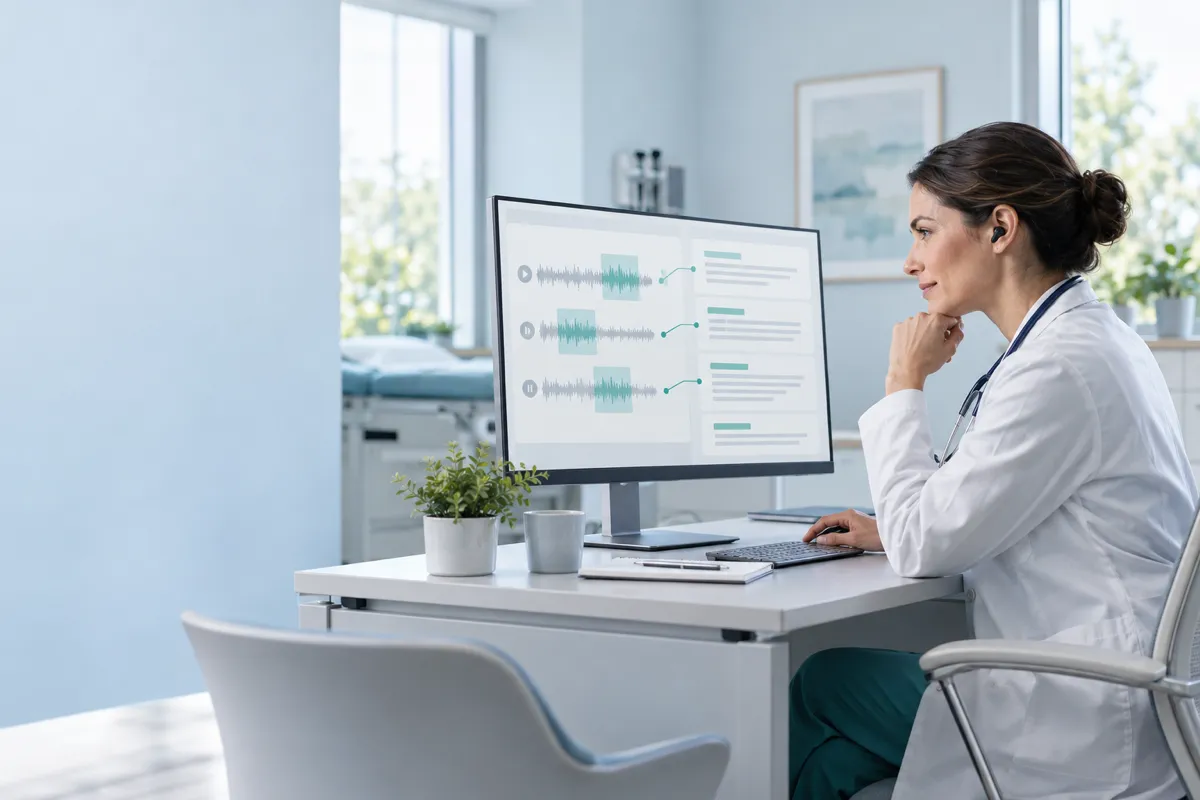
Othisis is an ambient AI medical scribe that captures the visit conversation and turns it into draft, structured documentation after the encounter, with 100% traceability to the relevant transcript/audio segment (click-to-hear verification) plus indexed references into uploaded PDFs so clinicians can verify where a detail came from before finalizing the record.
 
Evidence-linked AI is most valuable when verification is fast. Othisis brings document traceability to both the conversation and outside records helping teams draft confidently without pulling attention away from the patient.

Physician reviewing a monitor showing audio waveforms linked to note segments

Why Evidence-Linked AI Is High-Risk and High-Friction

PDFs are hard to trust at speed
Outside records arrive long, scanned, redundant, and inconsistent—making it easy to miss a key detail during time-pressured review.

Clinical facts must be verifiable, not just summarized
A usable draft needs dates, findings, medication changes, and “why” context plus a fast way to confirm the source.

Hidden inputs create risk and rework
Prior failures, contraindications, abnormal results, discharge changes, and outside recommendations can be buried deep and reintroduced incorrectly.

Documentation must be clear and defensible
AI support should keep source evidence easy to verify, not just summarize, so clinicians can finalize safely.

Workflow Coverage for Traceable AI Clinical Notes

Pre-Visit
  • Turn uploaded PDFs into a clean, structured snapshot

  • Summarize outside notes, discharge summaries, imaging reports, and labs with references to where details appear

  • Surface key dates, prior workups, and problem history from long packets

  • Organize “what’s in records vs what the patient reports” for quick validation

  • Reduce time spent hunting across PDFs before rooming

  • Flag unclear items to confirm in-room (conflicting meds, missing follow-up, uncertain timelines)

During Visit
  • Capture the conversation ambiently while you stay patient-facing

  • Document clarifications when the patient’s story conflicts with the PDF record

  • Capture “what changed since discharge” and “what’s actually being taken now” in context

  • Preserve encounter context around what was reviewed and what was confirmed

  • Maintain continuity by capturing patient goals, constraints, and key concerns as discussed

  • Session ends; the full transcript becomes the traceable foundation for every output that follows

After Visit
  • Draft review-ready note sections that reflect record review clearly and consistently

  • Link draft details to the relevant transcript/audio segment and indexed PDF references (click-to-hear, click-to-source verification)

  • Structure “outside records reviewed” content so key facts are easy to scan and confirm

  • Produce draft referral/insurance letters where source-backed history is needed

  • Keep everything editable with clinician review required before finalizing

  • Support fast finalization by keeping verification pathways visible (not hidden)

Built for Traceable AI Clinical Notes Across Every Visit Type

Traceable documentation tied to the source record
Structures documentation to match real chart-review workflow
Captures high-density record language accurately
Adapts to transitions of care and longitudinal follow-up

The focus remains on producing documentation that’s familiar, easy to review, and safer to finalize with clinician approval required before sign-off.

Document Intelligence for Traceable AI Clinical Notes

Source Traceability

Source Traceability

  • Audio source linkage: Connects each AI-generated statement to the exact moment in the consultation recording.
  • Document traceability: Links outputs to ingested PDFs, including referrals, prior labs, and historical notes.
  • Structured input mapping: Associates documentation with relevant structured clinical data fields.
  • Context verification: Enables clinicians to review the precise context behind symptoms, diagnoses, and treatment plans.
ICD-10 Code Linkage

ICD-10 Code Linkage

  • Structured ICD-10 mapping: Aligns documented diagnoses with appropriate ICD-10 codes.
  • Conversation traceability: Links each code to supporting evidence from the consultation.
  • Documentation validation: Connects coded diagnoses to ingested records and clinician review.
  • Billing and audit support: Enhances medical necessity justification, reimbursement clarity, and compliance readiness.
Interpretation Visibility

Interpretation Visibility

  • Structured interpretation transparency: Displays what was captured, how it was interpreted, and where it appears within the note.
  • Section-level visibility: Provides clarity across Problem List, Medications, Plan, and Follow-Up sections.
  • Source-to-structure mapping: Shows how raw inputs are organized into clinical documentation fields.
  • No black-box ambiguity: Ensures clinicians can fully understand and verify AI-generated structuring decisions.
Edit & Revision History

Edit & Revision History

  • Comprehensive edit logging: Tracks additions, deletions, corrections, and diagnostic code changes.
  • Version history control: Maintains a complete record of documentation revisions.
  • Pre-finalization transparency: Ensures all modifications are visible before approval.
  • Accountability assurance: Strengthens compliance and defensibility through traceable change management.

Explore Othisis for Traceable AI Clinical Notes

Start free trial. No credit card required.

Request Demo

Frequently Asked Questions

No. Othisis is an administrative support tool. Clinicians review and sign off on drafts.

It means key statements in the draft can be traced back to source context such as the relevant transcript/audio segment or the referenced part of an uploaded PDF so clinicians can verify before finalizing.

Yes. Othisis includes PDF processing and indexed references that help navigate long records during chart review.

Yes. Othisis indexes every generated note line back to the original audio segment or source PDF section. Clicking on any statement in the draft opens the exact transcript point or document reference it was drawn from, so sign-off is based on verified content, not assumption.

Yes. Othisis applies confidence scoring at two levels: PDF-to-text conversion quality (flagging sections where scanned or faxed documents may not have extracted cleanly) and ICD-10 coding cues (graded green, yellow, or red based on how strongly the documented encounter supports the suggested code). Low-confidence sections are surfaced for clinician review before finalization.

No. Othisis generates the full transcript and structured draft after the session ends, not during it. The clinician reviews the draft alongside the complete transcript before any output is approved, edited, or exported — nothing enters the record without explicit clinician sign-off.

This is where traceability has the most direct operational value. Othisis allows clinicians to click through to the exact patient statement, examination finding, or prior record reference that supports the original documentation decision — replacing memory-based reconstruction with dated, sourced evidence during appeals and audit reviews.