
Black Box vs. Glass Box: Why
Documentation AI Needs Verification
By The Othisis Team
The promise of AI in medicine is seductive: an intelligent assistant that handles the "grunt work" of clinical practice, listening to visits, organizing PDFs, and drafting notes so you can go home on time.
But for many clinicians and practice owners, that promise comes with a lingering question: Control.
In the rush to adopt new technology, there is a dangerous trend toward "Black Box" AI systems that ingest data and output a result without explanation. In a clinical setting, blind trust isn't just risky; it fundamentally changes the nature of the tool.
At Othisis Medtech, we are clear about our role. We do not practice medicine. We do not diagnose. We build Administrative Automation that empowers you to be the doctor.
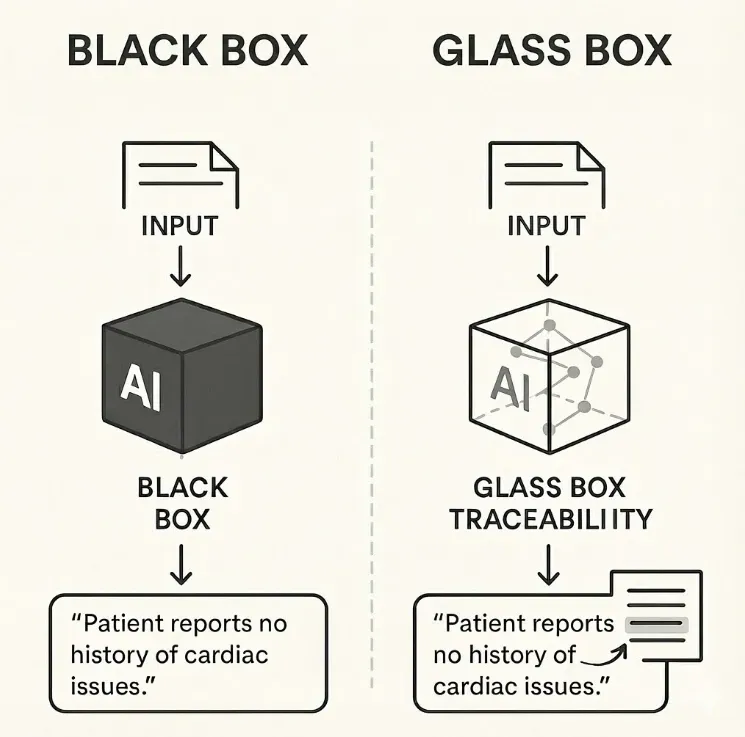
This is the difference between a "Black Box" that tries to think for you, and a "Glass Box" that works for you.
The Problem: The "Black Box" (Hidden Logic)
Most generic AI tools function as opaque boxes. You feed them a patient conversation or a referral letter, and they spit out a finished clinical summary.
- Input: Patient interview recording.
- Output: "Patient reports no history of cardiac issues."
But where did it find that? Did the patient say it, or did the AI infer it?
If you cannot see the source, you cannot verify the accuracy. If you cannot verify the accuracy, you are forced to abdicate your judgment to the software. That is not the role of technology in a practice. The physician must remain the final arbiter of the medical record.
The Solution: The "Glass Box" (Administrative Traceability)
When we built Othisis, we designed it specifically to support, not replace, clinical judgment. We operate on a Glass Box philosophy driven by Traceability.
Othisis acts as a hyper-efficient medical scribe and archivist. It organizes information and drafts documentation for your review, ensuring you never have to start from a blank page.
How Othisis Keeps You in the Loop:
- Mapping, Not Deciding: When Othisis ingests a PDF referral or listens to a visit, it maps the data points.
- The Digital Thread: When our system drafts a note using traceable AI clinical notes or suggests an administrative code (like ICD-10), it maintains a link back to the source text or transcript.
- Physician Verification: You don't just get a finished code; you get a suggestion with a citation. You can hover over the suggestion to see exactly where in the document the information was found.
This ensures that Othisis remains a tool for efficiency, not a diagnostic device. You are not relying on the software to make a clinical decision; you are using the software to surface the evidence you need to make that decision faster.
Beyond Scribing: Safe Workflow Automation
The need for a "Glass Box" approach is even more critical in back-office workflows, such as Referral Management.
When a specialist receives a complex patient history, standard automation tools might attempt to interpret clinical nuance. Othisis takes a safer, administrative approach. Whether used as an AI medical scribe for internal medicine or in specialized clinics, we parse and index the documents to highlight relevant history, allergies, and prior treatments, serving them up for your review.
By keeping the logic transparent, we ensure that:
- Liability remains clear: The physician approves every note.
- Accuracy is auditable: You can check the AI's work in seconds.
- Efficiency is real: You spend your time reviewing and approving, rather than hunting and pecking.
The "Human in the Loop" is the Future
The goal of Othisis is to end "Pajama Time," those hours spent on paperwork after the clinic closes. But true efficiency requires trust.
By building a system that champions transparency, traceability, and physician control, we ensure that technology stays in its lane: handling the administration so you can handle the medicine.
FAQs About Black Box vs Glass Box in Healthcare
- Every statement in a note can be audited
- Physicians explicitly approve final documentation
- Responsibility and liability remain clearly defined