
A primary care physician orders an MRI for a patient with worsening neurological symptoms. But the claim is denied, stating insufficient documentation of medical necessity. The physician’s notes clearly describe the symptoms and clinical reasoning, but not in the specific language and structure that utilization review requires.
According to the American Medical Association (AMA), 94% of physicians report that prior authorization delays access to necessary care. Utilization review has become a central friction point in medical practices.
Understanding how utilization review works and how documentation directly impacts outcomes is essential for reducing denials, minimizing administrative burden, and ensuring patients receive approved care without unnecessary delays.
What Is Utilization Review?
Utilization Review (UR) is the process insurance companies and payers use to evaluate whether requested medical services, procedures, or hospitalizations are medically necessary, appropriate, and aligned with coverage policies. UR can occur prospectively (before services), concurrently (during treatment), or retrospectively (after services are rendered).
In practice, UR creates administrative friction because clinical judgment must be translated into documentation language that satisfies standardized payer criteria, which is often reviewed by non-clinical staff.
Why Denials Happen
Most utilization review denials don’t reflect inappropriate care. They reflect documentation gaps such as:
Insufficient Documentation
Reviewers can not approve what isn’t written down.
For instance, "Patient has back pain" is not the same as "patient reports 8/10 lumbar pain radiating to left leg, present for 6 weeks despite NSAIDs and physical therapy, now limiting ability to work."
One gets approved, and one gets denied.
Missing Medical Necessity Justification
UR requires explicit evidence that conservative alternatives were considered or attempted. Ordering advanced imaging without documenting what was tried first and why it failed invites automatic denial.
Coding Errors
ICD-10 codes that don’t align with the requested service raise red flags. General codes where specific ones exist weaken the medical necessity argument before a reviewer even reads the notes.
Timing Issues
Requesting procedures before the required conservative treatment period has elapsed triggers policy-based denials, regardless of clinical judgment. Timing documentation matters as much as clinical documentation.
The Role of Documentation in UR Success
Effective medical necessity documentation isn’t about writing more. It’s about writing strategically.
What strong documentation includes:
- Symptom severity with measurable indicators (pain scales, functional limitations)
- Specific duration and progression of symptoms
- Prior treatments attempted, with timeframes and outcomes
- Explicit reasoning for why the next intervention is now necessary
- Examination findings that support the clinical concern
Common documentation gaps that cause denials:
- Vague or absent prior treatment history
- No explicit medical necessity statement
- Missing functional impact (how symptoms affect daily life or work)
- Incomplete examination findings
- Clinical reasoning is buried in information rather than stated upfront
When denials occur weeks or months later, physicians must reconstruct their clinical reasoning from memory if there is no proper documentation.
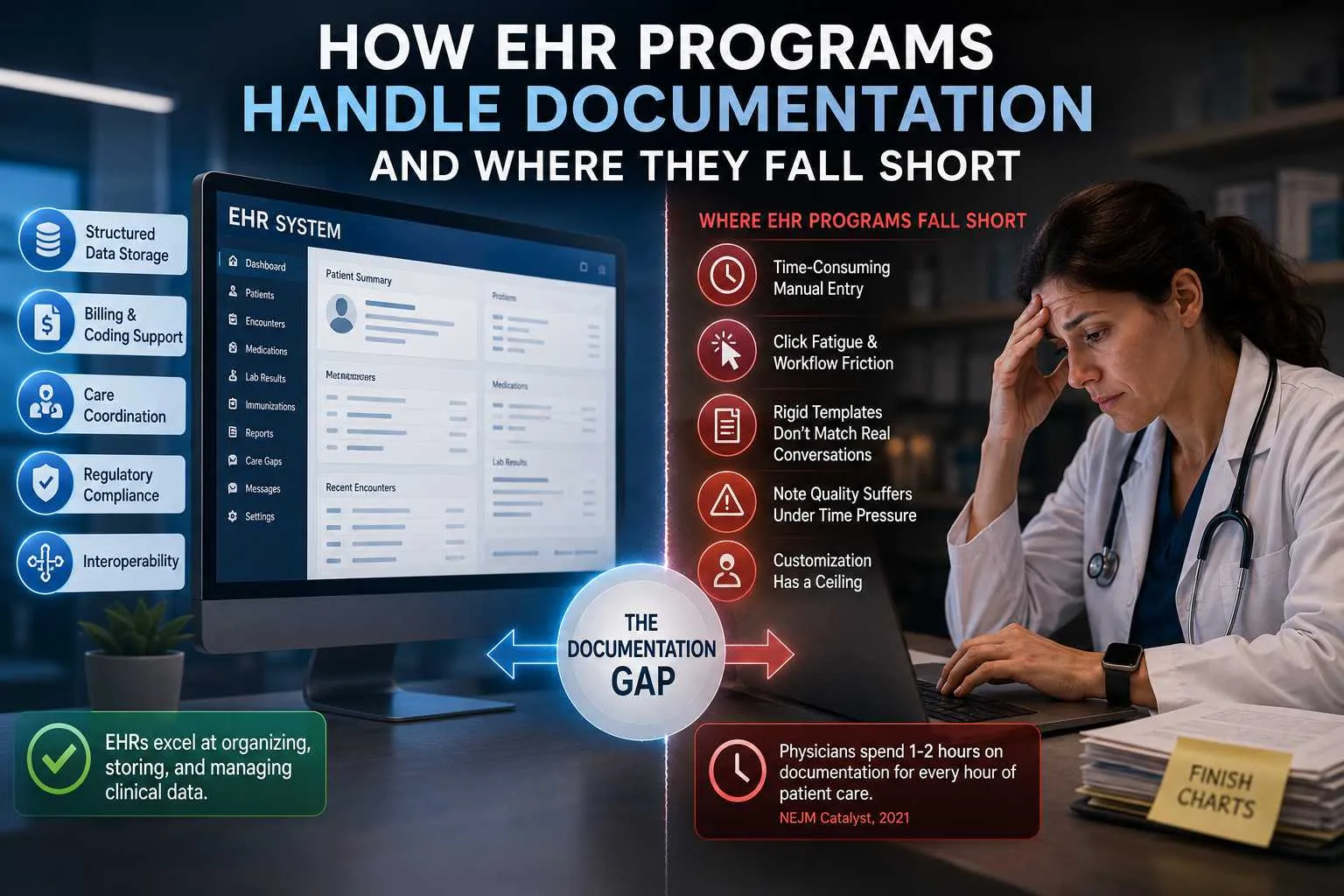
Physicians face significant documentation pressure. Research published in Annals of Internal Medicine found that during the office day, physicians spend only 27.0% of their time on direct clinical face time, while 49.2% is consumed by EHR and desk work.
This is where AI documentation systems come in. Documentation systems with source traceability capture the clinical reasoning discussed during the visit, making utilization review preparation faster and more defensible.
For example, if a physician orders an MRI for persistent lumbar pain, utilization review reviewers look for documented evidence that conservative treatments were attempted first. When symptom severity, prior treatments like NSAIDs or physical therapy, and their outcomes are clearly documented in the note, verifying medical necessity will be easier.
How Smarter Documentation Reduces UR Friction
Modern documentation tools, like Othisis’s AI documentation system, directly address utilization review friction through its core features:
AI Medical Scribe
The ambient AI medical scribe captures the full visit quietly in the background and delivers a structured draft note after the encounter. Physicians review, edit, and sign off before finalization.
Structured Clinical Notes
Templates prompt for UR-relevant elements such as chief complaint with severity indicators, prior treatment history, examination findings, and explicit medical necessity rationale consistently. Nothing critical gets buried or forgotten.
PDF Summarization
"PDF summarization ensures comprehensive documentation by automatically extracting and summarizing relevant history from a patient's extensive prior records. Medical record Summarization guarantees the full medical necessity timeline is documented without requiring manual review of lengthy records.
Traceability
When appeals are needed, click-to-source traceability references the exact patient statements and clinical findings that informed the original decision, replacing reliance on memory with concrete, dated proof to strengthen the case for approval.
Confidence Scoring
- PDF-to-text confidence scores
When PDFs or scanned records are uploaded, documentation-first AI platforms convert them into text for summarization. As scans, faxed documents, or complex tables may not extract perfectly, a confidence score indicates how reliably the document was converted into text, so clinicians know when a quick source check may be helpful.
- ICD-10 Coding Cues
From the documented visit conversation, AI medical scribes surface ICD-10 coding cues and display a confidence color showing how strongly the documented evidence supports the suggestion:
- Green: Highly correct based on documented evidence
- Yellow: Needs a quick clinician review
- Red: Low confidence and must be reviewed
All coding cues remain clinician-reviewed and editable. By helping clinicians verify documentation accuracy and coding alignment before submission, these indicators support clearer medical necessity documentation for utilization review.
The Bottom Line
Utilization review isn't going away, and neither is the administrative burden that comes with it.
But most denials aren’t inevitable. They’re the result of documentation that’s clinically sound but structurally incomplete. The fix isn’t writing longer notes. It’s writing notes that speak the language utilization review requires: specific, structured, and traceable from the first line.
When documentation captures symptom severity, treatment history, and medical necessity justification consistently, approval rates improve, and appeals become the exception rather than the norm.
The goal is documentation that works as hard as the physician behind it.