
Who We Are · Meet the Founder
Othisis was founded on a simple belief: clinicians became doctors to heal people, not to spend their evenings writing notes. We're here to give them that time back.
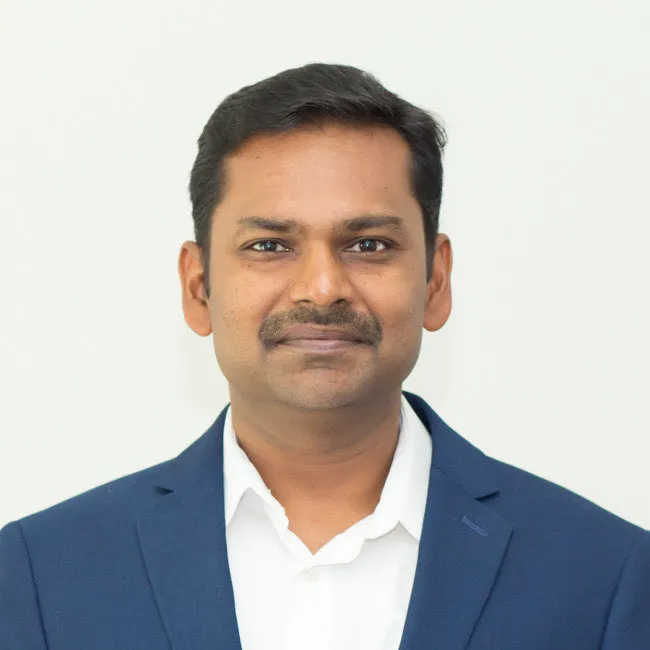
Founder & Visionary
Othisis was founded by someone who has spent a career doing one thing exceptionally well: taking large, complicated systems and making them actually work for the people who depend on them.
Across two decades of engineering and program management, Sreekanth learned that the hardest problems are rarely technical. They're human. The difference between a system that succeeds and one that fails comes down to whether it fits the person in the middle of it under pressure, on a deadline, with no room for error. That instinct for the human at the center is what healthcare's documentation crisis was missing, and it's the foundation Othisis is built on.
A career spent engineering systems that have to work every single time taught him to design for the user under real pressure, not the demo. That's why every Othisis output is built to be trusted in the room, not just impressive on a slide.
Leading large, cross-functional programs across multiple stakeholders and tight timelines is exactly the discipline a HIPAA-compliant clinical product demands where compliance, accuracy, and trust can't be afterthoughts.
Years of customer success and account leadership taught him that technology only matters if people actually use it. Othisis is designed to disappear into the clinician's workflow not add another tool to fight with.
The Problem We Solve
This is the quiet crisis inside modern medicine. Not a shortage of skill or compassion, but a system that asks the people we trust with our lives to spend more time describing care than delivering it.
For every 1 hour with patients
For every hour a physician spends face-to-face with a patient, nearly two more disappear into the keyboard clicking through fields, restructuring a conversation into a chart, fighting software that was built for billing departments, not bedsides. The encounter that should be the center of medicine has become the part there's least time for.
Pages no one has time to read
A new patient arrives carrying years of history (discharge summaries, specialist letters, labs, prior notes) scattered across dozens of PDFs and a half-dozen systems that don't speak to each other. The context needed to make a safe, confident decision exists. It's just buried, unsearchable, and waiting in a stack no clinician has the minutes to climb.
Physicians report burnout
When paperwork outpaces purpose, something gives. Roughly half of U.S. physicians now report burnout, with administrative load the leading cause and gaps in how information moves between providers remain a stubborn source of patient-safety risk. The documentation crisis isn't just an inconvenience. It quietly erodes both the healer and the healing.
Medical records were built to store information, never to serve the clinician in the moment they need it. That gap is the problem Othisis exists to close.
Our Approach
Othisis listens to the patient encounter and generates structured, specialty-accurate SOAP notes automatically, in the background, without disrupting the visit.
See AI ScribeUpload any clinical PDF (discharge summaries, referrals, prior notes) and Othisis distills it into a clear, actionable summary with every claim traceable to its source.
See PDF UploadEvery Othisis output is a starting point, not a final word. Clinicians review, verify, and approve because the decision always belongs to the doctor, never the model.
"The best engineers I ever worked with didn't design systems for themselves, they designed them for the person who'd depend on them at 2 a.m. That's exactly how we build Othisis."