
Othisis Medtech
VISION CLINICS

Chat with Medical Records AI, Made Traceable

Documentation support built to reduce chart digging, missed history, and after-hours prep.
 
Othisis is an ambient AI medical scribe that captures the visit conversation and produces draft, structured documentation after the encounter, while supporting PDF-based record summarization. It provides traceability to the relevant transcript/audio segment (click-to-hear verification) plus indexed references into uploaded PDFs, so clinicians can verify what came from the encounter vs what came from prior records before finalizing.
 
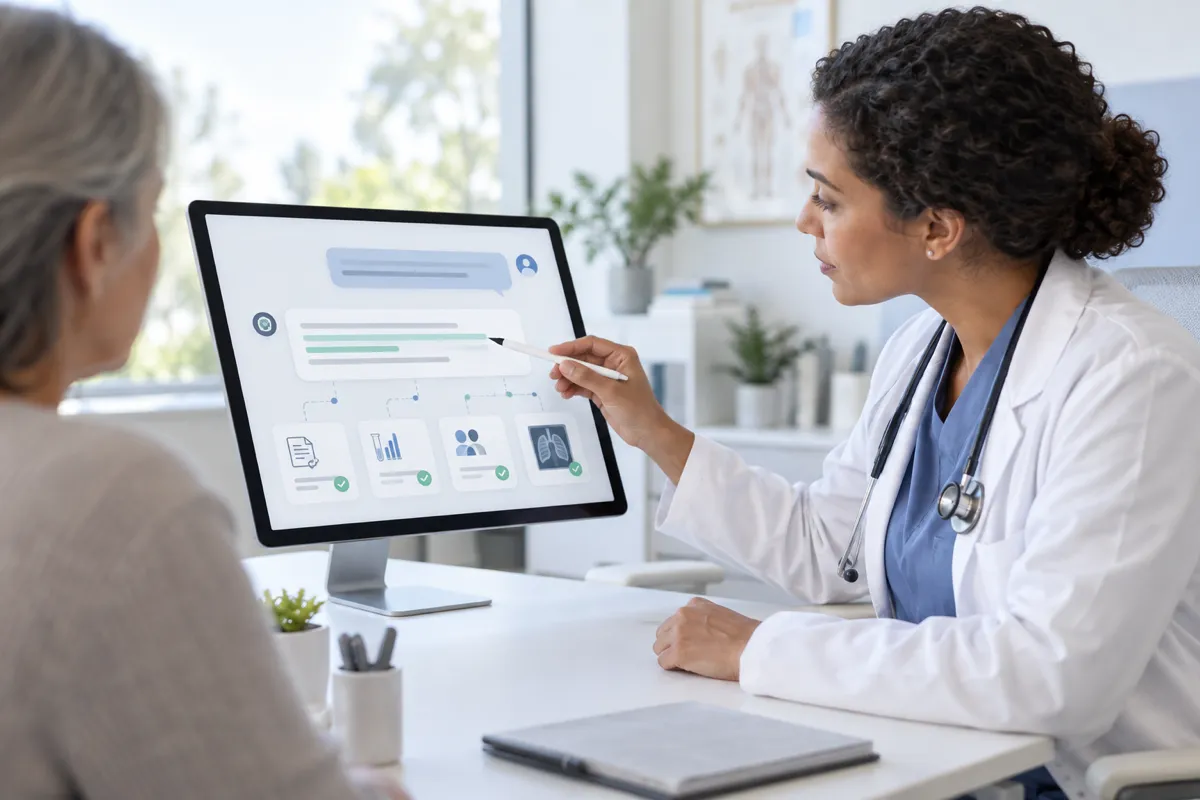
When teams search for Chat with medical records AI, what they often need is faster answers from messy charts with evidence visible. Othisis supports conversational, query-style chart review by helping clinicians locate key history across PDFs and prior documentation while keeping verification easy.

Cardiologist working

Conversational Chart Review Is High-Friction and High-Risk

Patient records are rarely in one place
Key details live across PDFs, outside consults, imaging reports, discharge summaries, and prior notes—often fragmented, repetitive, and hard to search quickly.

Questions require verification-level answers
Clinicians need dates, results, medication changes, and “why” context not just a summary especially when decisions depend on specifics.

Hidden drift creates rework and uncertainty
Copy-forward, outdated problem lists, and conflicting outside records can reappear unless the source can be checked quickly.

Documentation must be clear and defensible
AI support should keep source evidence easy to verify not just summarize so clinicians can finalize safely with clinician review.

Specialty Workflow Coverage 

Pre-Visit
  • Turn uploaded PDFs into a clean, structured snapshot

  • Summarize long outside packets into high-signal sections for rapid review

  • Surface key dates, diagnoses, procedures, and prior workups from multi-file records

  • Organize “what’s in records vs what the patient reports” for quick validation

  • Reduce time spent hunting across documents before rooming

  • Flag unclear items to confirm in-room (conflicting meds, missing follow-up, uncertain timelines)

During Visit
  • Capture the conversation ambiently while you stay patient-facing

  • Document clarifications when the patient’s story differs from the record

  • Capture “what changed since last visit” and “what matters today” in context

  • Preserve decision points and counseling that explain why the plan is shifting

  • Keep encounter vs prior-history details distinct and reviewable before sign-off

  • Maintain continuity by recording what was reviewed and what was confirmed in the encounter

After Visit
  • Draft review-ready note sections that reflect record context clearly

  • Draft review-ready note sections that reflect record context clearly

  • Create draft patient-friendly summaries when appropriate (for clinician review)

  • Create draft patient-friendly summaries when appropriate (for clinician review)

  • Keep everything editable with clinician review required before finalizing

  • Keep verification pathways visible so clinicians can validate key facts quickly

Built for Chat with Medical Records AI Across Every Visit Type

Traceable answers tied to source records
Structures chart review to match real workflow
Supports high-density “query patient history” use cases
Adapts to transitions of care and longitudinal follow-up

The focus remains on producing documentation that’s familiar, easy to review, and safer to finalize with clinician approval required before sign-off.

Document Intelligence for Vision Clinics

Specialty-Aware Document Intelligence (Before & During Visit)

Specialty-Aware Document Intelligence:

  • Key diagnoses and events referenced across multiple PDFs and prior notes
  • Imaging impressions, labs, and procedure results buried deep in long packets
  • Medication changes, discharge regimens, and follow-up plans from transitions of care
  • Prior treatment trials, failures, and contraindications relevant to next steps
  • Timelines and dates that matter for interpretation and authorizations
  • Conflicts between “what the record says” and “what the patient reports now”
  • Context for why plans changed (response, side effects, new findings)
High-Fidelity Clinical Documentation

High-Fidelity Clinical Documentation

  • Hospital/ED follow-ups (transition of care)
  • New patient intakes with extensive outside documentation
  • Specialty consults requiring synthesis of prior workups
  • Chronic disease management with frequent external notes
  • Pre-op / clearance visits where record verification matters
  • Routine follow-ups where “records reviewed” must be documented clearly
Accuracy, Traceability & Risk Controls

Accuracy, Traceability & Risk Controls

  • Missing key findings due to document volume or scanning quality
  • Conflicting facts across PDFs, older notes, and patient-reported history
  • Misreading medication changes after hospitalizations or outside consults
  • Losing dates, values, or “why” context that drives decisions
  • Timeline drift from outdated problem lists and copy-forward content
  • Overreliance on summaries when source context is needed for review
Time, Throughput & Revenue Efficiency

Time, Throughput & Sustainability

  • Reduce pre-charting time and post-visit rework
  • Improve consistency in how outside records are summarized across providers
  • Make key facts easier to locate during future visits and authorizations
  • Decrease time spent searching PDFs and old notes for evidence
  • Preserve clinician focus on the patient instead of document hunting
  • Finish documentation during clinic hours instead of taking work home
Designed for Ophthalmology & Optometry Practices

Designed for Clinics Managing High-Volume Patient Records

  • Primary care clinics receiving frequent outside records
  • Specialty practices working from referral packets and long histories
  • Community health centers handling fragmented documentation sources
  • Hospital-affiliated outpatient clinics managing transitions of care
  • Multi-provider groups coordinating ongoing chart review across teams
  • Practices receiving large PDF packets that must be summarized for context

Explore Othisis for Chat with Medical Records AI

Start free trial. No credit card required.

Request Demo

Frequently Asked Questions

No. Othisis supports documentation workflows. Clinicians review and sign off on drafts.

Othisis supports conversational, query-style chart review by summarizing PDFs and providing indexed references so clinicians can locate key information faster while keeping verification visible.

Othisis does not publicly claim direct EHR integration; avoid stating this unless your team has verified it.