
If you've spent any time practicing medicine in the last decade, you know the rhythm well: see the patient, end the appointment, then spend the next ten to twenty minutes catching up on documentation inside your EHR program. Multiply that across a full day of encounters, and you're looking at two to three hours of after-hours charting every single day.
EHR programs were built to solve a real problem: organizing, storing, and retrieving clinical data at scale. They do that. But somewhere along the way, physicians were handed the expectation that they would also be the primary data-entry operators. The result is a documentation burden that contributes directly to what the American Medical Association calls a "professional satisfaction crisis" with over 63% of US physicians reporting at least one symptom of burnout, and documentation consistently cited as the top driver.
This post breaks down what EHR programs genuinely do well, where they fall structurally short on documentation, what that time cost looks like in real numbers, and why an ambient AI medical scribe not a replacement EHR is the answer most practices are missing.
What EHR Programs Were Designed to Do Well
It's worth being fair: EHR programs have transformed healthcare in measurable, meaningful ways. Before widespread EHR adoption, care coordination between providers was fragmented. Paper charts got lost. Medication histories were incomplete. Lab results lived in silos.
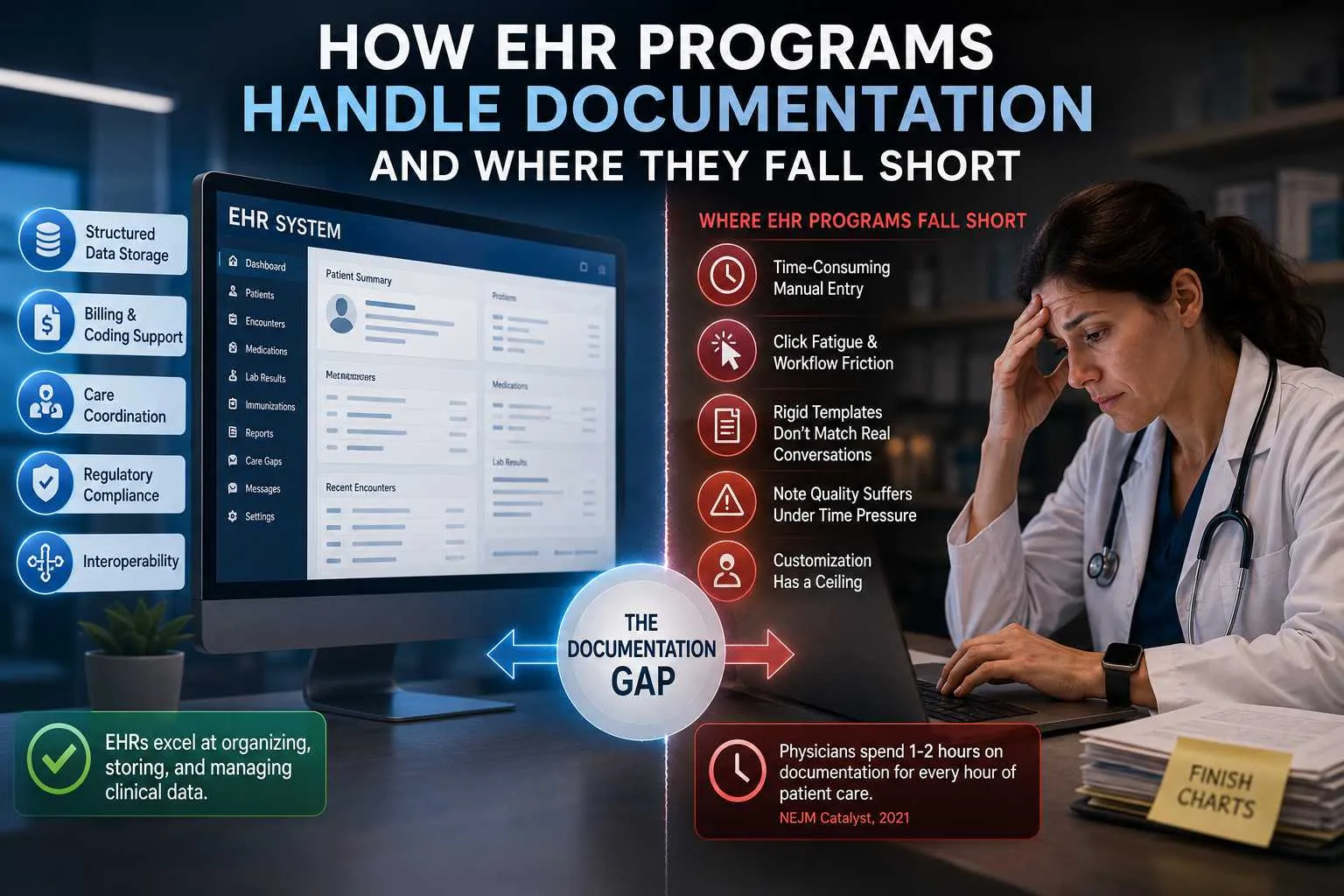
Today's EHR programs Epic, athenahealth, Cerner, eClinicalWorks, and others excel at several things:
- Structured data storage: Diagnoses, vitals, lab results, medication lists, immunization records, and problem lists are organized, searchable, and persistent across encounters.
- Billing and coding support: CPT and ICD-10 code linkage, claim generation, and payer-specific documentation requirements are built into the workflow.
- Care coordination: Referral management, care gap alerts, and population health dashboards help practices manage panels at scale.
- Regulatory compliance: EHR programs maintain audit trails, support meaningful use requirements, and handle HIPAA-compliant data storage by design.
- Interoperability: With HL7 FHIR standards maturing, most major EHR programs now support data exchange across health systems and specialty networks.
These are not small achievements. A well-implemented EHR program is the operational backbone of any modern practice.
But the backbone is not the same as the brain. And when it comes to the actual drafting of clinical notes, EHR programs have a fundamental structural limitation one that no software update has yet solved.
Where EHR Programs Fall Short: The Documentation Gap
Here is the uncomfortable truth about EHR programs: they capture data, but they don't create it.
Every note you write in your EHR the HPI, the assessment and plan, the ROS, the physical exam narrative was typed or clicked into existence by a human. Usually you. Sometimes a scribe. Occasionally a copy-paste from a prior encounter (a practice that carries its own clinical and legal risk).
EHR programs were architected around structured data entry, not natural language generation. The templates, pick-lists, and dropdown menus that feel like "help" are actually just faster ways to manually input data they don't observe the clinical encounter and draft a note from it. That requires a fundamentally different layer of technology.
The specific documentation gaps that physicians report most frequently include:
1. Note templates don't match real conversations. Clinical encounters are fluid and non-linear. Patients bring up three concerns when you asked about one. Comorbidities intersect. EHR templates impose a rigid structure Chief Complaint, then HPI, then ROS on conversations that don't follow that order. Physicians end up either retrofitting their notes or clicking through irrelevant fields to reach the ones that matter.
2. Click fatigue is a documented clinical problem. A 2022 study published in the Journal of the American Medical Informatics Association found that primary care physicians averaged 18 minutes of EHR time per encounter, with a significant portion spent on repetitive clicks and redundant data entry. That's not clinical time that's administrative overhead disguised as workflow.
3. EHR note quality suffers under time pressure. When physicians are rushing to catch up on a 20-patient schedule, notes get abbreviated. Nuance gets dropped. The clinical reasoning that would be valuable for the next provider or for a malpractice review six months later doesn't make it into the record. Not because physicians don't care, but because there isn't time.
4. Customization has a ceiling. Yes, you can build smart phrases. Yes, you can customize your templates. But customization in an EHR program takes time to build, time to maintain, and still requires manual activation. It's not intelligent it doesn't adapt to what's actually being discussed in the room.
What the Time Cost Actually Looks Like
The documentation burden imposed by EHR programs isn't theoretical. It has been quantified repeatedly and the numbers are stark:
- Physicians spend 1–2 hours on EHR documentation for every hour of direct patient care (NEJM Catalyst, 2021).
- Primary care physicians log an average of 5.9 hours of EHR time per day, with nearly half occurring outside of scheduled clinic hours (Annals of Family Medicine, 2020).
- Over 34% of a physician's EHR time is spent on documentation tasks alone separate from ordering, reviewing results, or communicating with care teams (Journal of General Internal Medicine, 2017).
For a solo practitioner or small group practice, this translates directly to revenue pressure. Hours spent charting after clinic are hours not available for additional patient volume, professional development, or basic as it sounds rest.
For health systems, the math is larger. A 10-physician primary care group collectively losing 5+ hours per week per physician to documentation overhead represents tens of thousands of dollars in opportunity cost annually, before accounting for the turnover risk that comes with physician burnout.
Why an AI Medical Scribe Fills the Gap Without Replacing Your EHR
Here's where the conversation shifts from problem to solution and the framing matters.
An AI medical scribe doesn't replace your EHR program. It fills the gap your EHR program was never designed to fill.
Othisis Medtech's AI medical scribe operates in the ambient layer listening to the clinical encounter as it happens (with patient consent), then drafting a structured clinical note as soon as you complete the session. That note is drafted and ready for your review by the time the patient walks out the door.
What this means in practice:
- No post-visit dictation. The note is drafted from the live conversation, not reconstructed from memory afterward.
- No template-clicking mid-encounter. You're present with your patient, not split between the clinical moment and the EHR screen.
- Structured output, ready for your chart. The draft is a standard SOAP note you approve and copy into your EHR.
- Full physician review before sign-off. Every note is reviewed and edited by the physician before it's finalized. Othisis is a documentation tool, not an autonomous charting agent. You remain in control.
The "glass box, not black box" design means you can see exactly what was captured, what was interpreted, and why the note reads the way it does. There are no hidden AI decisions in your clinical record.
time that goes back to patient care, or simply back to having an evening that doesn't involve finishing charts at 10 PM.
The EHR Isn't the Problem. The Documentation Burden Is.
EHR programs are not going away, and they shouldn't. The structured data, the interoperability, the billing infrastructure that's core to how modern medicine operates. But the idea that EHR programs should also be the primary documentation interface for physicians the people who went to medical school to practice medicine, not type was always a design compromise, not a design solution.
The gap between what happened in the exam room and what ends up in the EHR note is a real, measurable, costly gap. It costs physician time, note quality, and in too many cases, physician wellbeing.
Ambient AI scribing doesn't try to replace the EHR. It works alongside it handling the one thing the EHR was never built to do: observing the encounter and drafting the note so the physician doesn't have to.
See How Othisis Works With Your Current EHR
If you're spending more than 90 minutes a day on documentation inside your EHR program, that's time an AI medical scribe should be handling for you.
Othisis Medtech works alongside the EHR program your practice already uses. There's no integration project: you approve the note in Othisis and copy it into the chart. Setup takes minutes. And there's no commitment required to see if it works for your workflow.
Try for Free No Card Required →
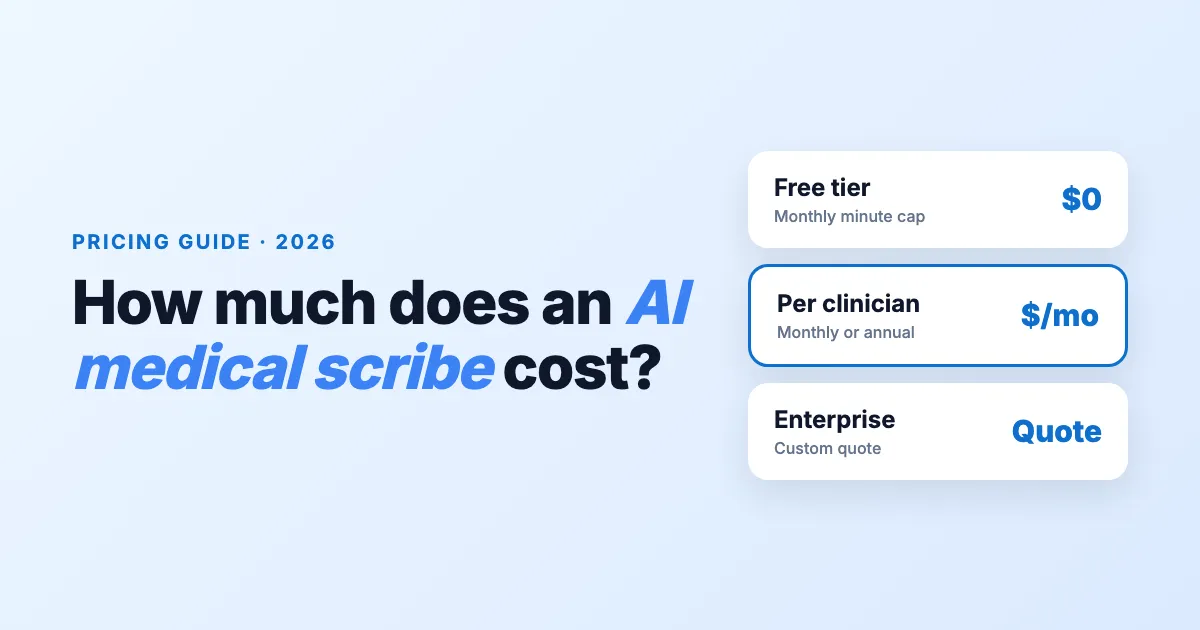
You can start free, and paid plans start at $149/month. At $249/month, the Pro plan includes 15,000 minutes of transcription a month for up to 5 users. Compare all options at othisismedtech.com/pricing.
Your EHR isn't going anywhere. But your after-hours charting should be.
Othisis Medtech is a documentation assistance tool. It is not a diagnostic system and does not provide clinical recommendations or treatment guidance