
Most Clinicians Trust Their AI Scribe Without Ever Checking Its HIPAA Status
Here's a scenario that plays out more often than anyone in healthcare technology wants to admit: a solo clinician downloads an AI scribe app, clicks through the terms of service, and starts recording patient encounters the same afternoon. The tool works well. Notes are cleaner. Charting time drops by 40 minutes a day. Life gets easier.
And then months later they discover the tool they've been relying on never signed a Business Associate Agreement with them. Or that patient audio was being processed on servers outside the United States. Or that there are no audit logs to prove who accessed what and when.
This is not a hypothetical. As AI scribe adoption accelerates into 2026, compliance gaps in the tools clinicians use daily are quietly becoming one of the most serious risk exposures in solo and small practice medicine. The Office for Civil Rights (OCR) at the Department of Health and Human Services does not distinguish between a covered entity that knowingly violated HIPAA and one that simply failed to do its due diligence. The financial penalties and the reputational damage can be equally devastating.
The good news is that choosing a genuinely HIPAA-compliant AI scribe is straightforward once you know exactly what to look for. This guide will walk you through what HIPAA actually demands from an AI documentation tool, the seven questions you must ask any vendor before you commit, and why the architecture of the tool matters just as much as the policy documents they hand you.
What HIPAA Actually Requires from an AI Medical Scribe
Many clinicians assume that if a vendor uses words like "secure," "encrypted," or "privacy-first" in their marketing, HIPAA compliance is implied. It is not. HIPAA compliance is a legal designation with specific, enforceable requirements not a brand claim.
When you bring an AI Medical Scribe into your clinical workflow, that tool is processing Protected Health Information (PHI) on your behalf. Under HIPAA, any third-party vendor that touches PHI is classified as a Business Associate. That relationship must be formalized before a single patient encounter is recorded.
Here is what true HIPAA compliance looks like in practice for an AI scribe tool:
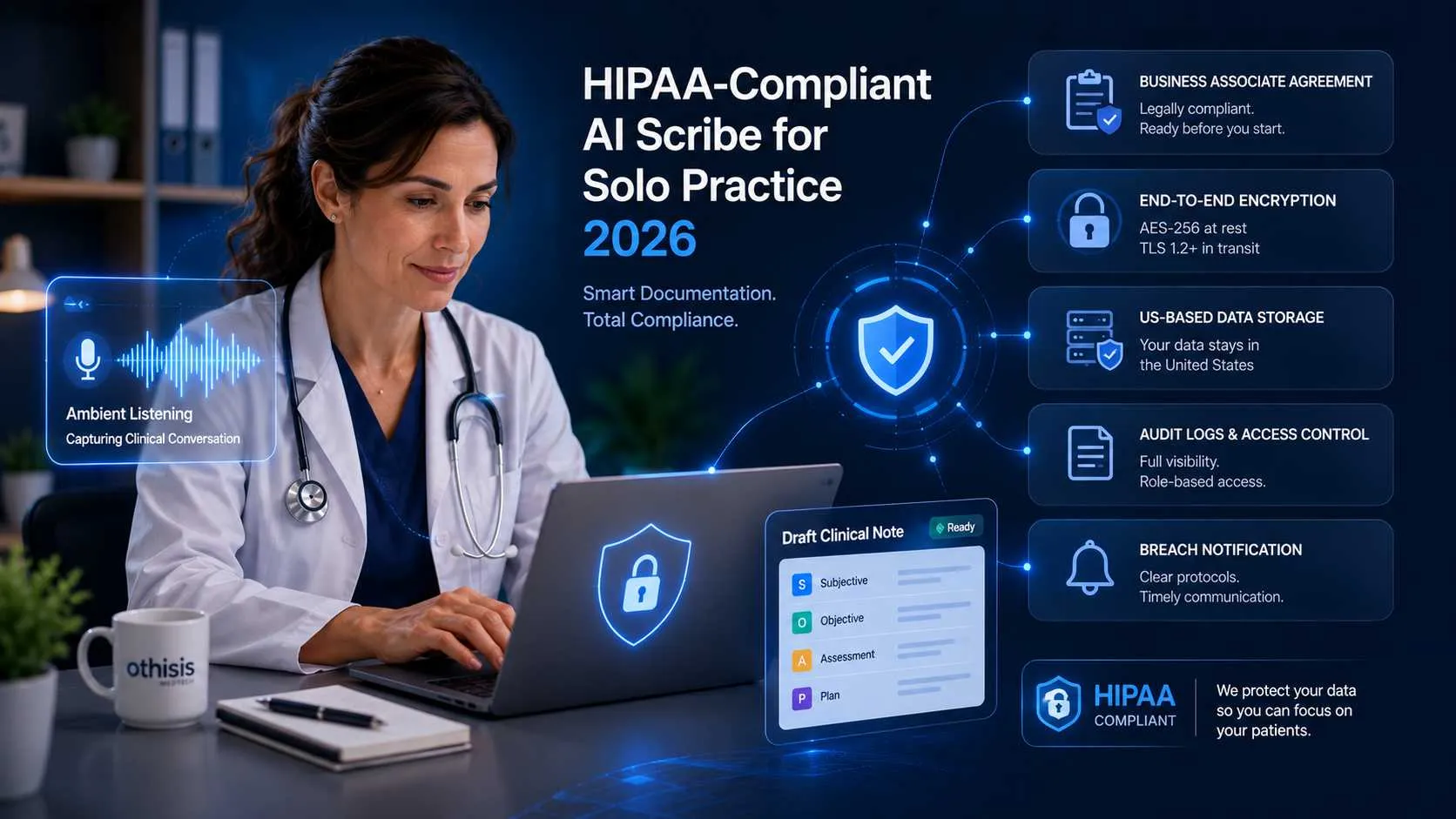
Business Associate Agreement (BAA). A legally binding BAA must be executed between you (the covered entity) and the AI scribe vendor (the business associate) before the tool processes any PHI. The BAA defines each party's responsibilities for safeguarding that data, what happens in the event of a breach, and how PHI is handled when the relationship ends. If a vendor cannot or will not sign a BAA, the conversation is over full stop.
Data Residency and Storage Location. PHI must be stored in the United States on servers that meet HIPAA's physical safeguard requirements. Some AI scribe tools route audio or transcription data through overseas processing infrastructure, which creates immediate compliance exposure. You need written confirmation of where your data lives, not a verbal assurance.
Encryption in Transit and at Rest. HIPAA's technical safeguard standards require that ePHI (electronic PHI) be protected both while it is being transmitted and while it is stored. Industry standard is AES-256 encryption at rest and TLS 1.2 or higher in transit. Any vendor who cannot specify their encryption standards is not ready for healthcare.
Audit Logs and Access Controls. HIPAA requires covered entities to maintain detailed audit logs that record who accessed PHI, when, and what actions were taken. Your AI scribe vendor must be able to demonstrate that access to your patient data is logged, controlled, and reviewable. Role-based access controls ensuring only authorized users can see specific data are a non-negotiable element of a compliant system.
Breach Notification Protocols. In the event of a data breach, HIPAA mandates specific timelines and procedures for notification. Your BAA should clearly specify how and when the vendor will notify you if a breach occurs, so you can fulfill your own reporting obligations to patients and the OCR.
Understanding these requirements is the foundation. Now let's translate them into the questions you should be asking every vendor on your shortlist.
The 7 Questions Every Clinician Must Ask Before Choosing an AI Scribe
Before you sign up for any AI scribe tool free trial or paid plan run every vendor through this checklist. The quality of their answers will tell you everything.
1. Will You Sign a Business Associate Agreement Before I Use the Product?
This is a binary question. The answer must be yes, and the BAA must be executed before you record a single patient encounter. Some vendors bury the BAA process in a support ticket workflow or require you to be on a paid plan to access it. That is a red flag. Any HIPAA-compliant AI medical scribe should have a BAA readily available and easy to execute.
2. Where Exactly Is My Patient Data Stored and Processed?
Ask for written documentation specifying the geographic location of all servers involved in processing and storing your patient data. This includes audio capture, transcription processing, note generation, and long-term storage. "US-based servers" is the floor, not a differentiator. Push for specifics on cloud providers, data center locations, and whether any subprocessors are involved and whether those subprocessors also have BAAs in place.
3. What Encryption Standards Do You Use, and Can You Document Them?
Do not accept a vague answer. You want the specific encryption protocol used at rest (AES-256 is standard) and in transit (TLS 1.2 minimum, TLS 1.3 preferred). Ask whether audio recordings are encrypted before transmission and whether the transcription pipeline itself operates in an encrypted environment. A vendor confident in their security posture will answer this question without hesitation.
4. Does My Audio or Patient Data Train Your AI Models?
This is the question many clinicians forget to ask and the one that catches several popular consumer-grade transcription tools off guard. Some AI tools use customer interactions to improve their underlying models. In a healthcare context, this means patient conversations could theoretically be used as training data, which creates serious HIPAA implications. A compliant vendor will have a clear, written policy confirming that your data is never used to train shared AI models.
5. What Access Controls and Audit Logging Does the System Provide?
You need to know who within the vendor's organization can access your patient data and under what circumstances. Ask about their internal access control policies, whether their staff undergo HIPAA training, and whether you can pull audit logs as the practice owner to see your own access history. Audit logging is not optional under HIPAA it is a documented requirement of the Security Rule.
6. What Is Your Breach Notification Timeline and Process?
Under HIPAA's Breach Notification Rule, business associates must notify covered entities of a breach without unreasonable delay and no later than 60 days after discovery. Your BAA should spell this out explicitly. Ask the vendor what their internal incident response process looks like, how quickly they have historically identified breaches in testing scenarios, and who your point of contact would be in the event of an incident.
7. Can You Provide a Security Summary or HIPAA Compliance Documentation I Can Keep for My Records?
A compliant vendor will be able to produce documentation of their security posture whether that's a SOC 2 Type II report, a HIPAA risk assessment summary, or a formal security white paper. This matters for your own compliance records. If OCR ever audits your practice, you will need to demonstrate that you performed due diligence before engaging any business associate who handled PHI. Documentation from the vendor is part of that evidence.
Why Mental Health and Psychiatry Practices Face Stricter Rules
If you practice in behavioral health, addiction medicine, or psychiatry, standard HIPAA compliance is the floor not the ceiling. Federal regulations under 42 CFR Part 2 impose additional, stricter protections on records related to substance use disorder treatment. Many states also have independent mental health privacy laws that layer on top of HIPAA's federal baseline.
How Othisis Is Built for HIPAA Compliance by Default Not Bolted On
There is a meaningful difference between a tool that was designed for consumer use and then adapted for healthcare, and a tool that was architected for clinical environments from the ground up. Othisis falls firmly in the second category.
Othisis is a secure AI scribe for doctors built on what the company calls a "glass box" philosophy transparent AI that clinicians can see, verify, and trust. That transparency extends to its compliance posture. Othisis provides a BAA on request, so a practice can put one in place before it uses the product with patient data. HIPAA-compliant operation is the default, not an enterprise add-on.
Key elements of the Othisis compliance architecture include:
- BAA available on request on any plan, including the free Starter plan. Contact us to set one up before using patient data
- Encryption in transit (TLS 1.2 or higher) and at rest (AES-256)
- Activity is recorded in an audit log, and every note keeps a version history showing who saved each version and when
- No training on your data: Othisis doesn't use patient data to train AI models, and its transcription requests opt out of the vendor's model training
- Sign-in through Microsoft Entra ID, automatic sign-out after 15 minutes idle, and team roles (Owner, Admin, Member) that control who can invite teammates and manage billing
Othisis is also purpose-built to stay in its lane. It generates clinical documentation (structured SOAP notes, referral and insurance letters, patient handouts and PDF summaries) but it does not interpret clinical findings, suggest diagnoses, or make care recommendations. Every clinical judgment remains exactly where it belongs: with you, the licensed clinician. This "glass box" approach means you always know what the AI is doing and why, which is essential for maintaining both clinical integrity and regulatory accountability.
View Othisis pricing to see which plan fits your practice volume and documentation needs. Whether you are evaluating for a solo panel or a small group practice, there is a compliant, affordable starting point.
Red Flags to Watch for in AI Scribe Tools
Not every compliance failure is obvious. Here are the warning signs that should prompt you to walk away from an AI scribe vendor or at minimum, ask much harder questions:
No BAA on the free plan. If a vendor says you need to upgrade to a paid tier to execute a BAA, that means the free version of the product is not HIPAA-compliant. Using it with patients even briefly, even in a trial context creates real liability.
Vague language about data storage. Phrases like "secure cloud infrastructure" or "enterprise-grade security" without specifics on geographic location, encryption standards, or subprocessor disclosure are marketing language, not compliance documentation.
Terms of service that reserve rights to use your data. This is common in consumer-grade AI tools. If the terms of service include any language about using aggregated data, improving models, or sharing anonymized insights, read it carefully. In a healthcare context, "anonymized" is not always the safe harbor it appears to be.
No answer to the breach notification question. A compliant vendor has a documented incident response plan. If the sales rep cannot answer your breach notification question or tells you to "check the terms" that vendor has not internalized HIPAA as an operational requirement.
Consumer app infrastructure. Some AI scribe tools are built on general-purpose transcription APIs (from major consumer tech platforms) that were not designed for healthcare. Passing PHI through a consumer transcription layer even briefly is a compliance risk, regardless of what the AI scribe vendor claims.
The Bottom Line: Compliance Isn't a Feature It's the Foundation
Solo clinicians are increasingly choosing AI scribe tools to reclaim their time, reduce documentation burden, and stay present during patient encounters. That is the right instinct. The wrong move is to let convenience outrun compliance.
The HIPAA-compliant AI scribe you choose should be able to satisfy every question in this guide not with marketing copy, but with documentation, signed agreements, and architectural transparency. Anything less is a liability you are absorbing on behalf of your patients and your practice.
Othisis was built to meet that standard from day one. If you're ready to see what a truly compliant, transparent AI scribe looks like in a real clinical workflow, start with the free plan, and ask us for a BAA before you use it with patient data.
Try Othisis Free → https://app.othisismedtech.com/auth/signup
Disclaimer: Othisis is a clinical documentation tool. It does not make clinical decisions, provide diagnoses, or offer medical advice. All clinical judgments remain with the licensed clinician.