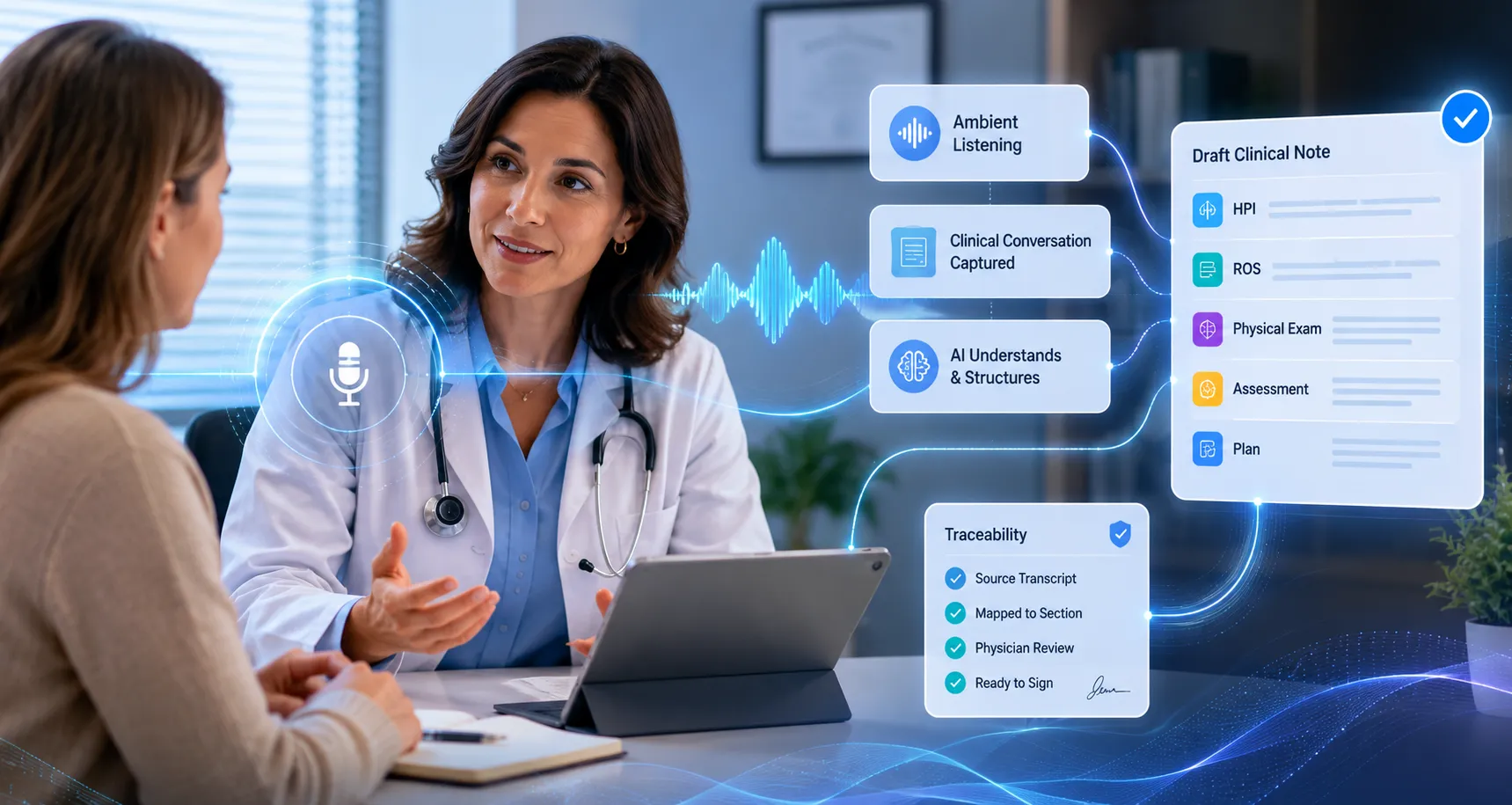
Ambient clinical intelligence refers to AI technology that passively captures clinical conversations in real time without requiring manual input from the physician and automatically converts those conversations into structured clinical documentation. It is not a diagnostic system. It does not replace clinical judgment. It does not touch the EHR without physician review. What it does is handle the documentation that currently follows every clinical encounter, so the physician doesn't have to.
That's the definition. And if you've never heard the term before, you're not alone. "Ambient clinical intelligence" is the technical category name for what most clinicians are beginning to encounter as "AI medical scribes" or "ambient AI scribing." The term comes from the broader field of ambient computing technology that operates in the background of an environment without requiring deliberate activation.
In healthcare, it means the AI is in the room. Listening. Structuring. Drafting. And doing all of it without interrupting the clinical encounter. This is the core of what we call ambient clinical intelligence - capturing the visit without disrupting the conversation.
This post demystifies what ambient clinical intelligence actually is, walks through exactly what happens during a consultation when it's active, clarifies what it does not do (a critically important line for clinicians and compliance teams alike), and explains why the traceability model matters for the physicians who use it.
What Ambient Clinical Intelligence Actually Means
The term breaks down into three components:
Ambient - the system operates passively in the clinical environment once activated. The physician does not need to dictate into it, manually document during the conversation, or continuously interact with the system throughout the encounter. After the session is started, the AI listens in the background, captures the clinical conversation, and generates a structured draft note for physician review.
Clinical - the AI is trained on medical language, clinical workflows, and healthcare documentation standards. It understands the difference between a chief complaint and an assessment, between a review of systems and a physical exam finding, between a medication history and an active prescription.
Intelligence - it doesn't just transcribe. It interprets. It understands that when a patient says "my chest has been tight for about three weeks, mostly in the mornings," that's an HPI element, not a social history entry. It structures clinical content into the appropriate sections of a note SOAP format, specialty-specific templates, or custom formats without being told how to categorize each utterance.
The result is a system that converts a natural, unscripted clinical conversation into a draft clinical note that is ready for physician review within seconds of the encounter ending.
Othisis Medtech's AI medical scribe is an ambient clinical intelligence platform built for US-based clinical practices. It listens during encounters, drafts structured notes, and fits alongside your existing EHR workflow without changing how clinicians talk with their patients.
What Happens During a Consultation, Step by Step
Understanding ambient clinical intelligence is easier when you walk through exactly what happens during a real encounter.
Step 1: Encounter activation Before the consultation begins, patient consent is obtained through the practice's established workflow. Once consent has been confirmed, the clinician activates the Othisis session with a single tap, and the system begins ambient listening for the encounter.
Step 2: The encounter proceeds normally The clinician sees the patient. They talk. They listen. They examine. There is no microphone to hold, no dictation to narrate, no template to click through mid-conversation. The ambient AI captures the full audio stream of the clinical dialogue.
Step 3: Real-time processing As the conversation unfolds, the AI captures the clinical dialogue. Once the clinician marks the encounter as complete, the AI processes the audio, converts it to text, identifies clinical entities (symptoms, duration, medications, relevant history), and maps each piece of information to its corresponding note section.
Step 4: Structured note generation When the encounter ends, the AI produces a complete draft clinical note, typically in SOAP format or the specialty-specific format the practice uses. The note includes the HPI, ROS, physical exam findings (as discussed), assessment and plan, and any relevant follow-up instructions. In addition to clinical notes, Othisis can generate supporting documentation such as referral letters, insurance letter drafts, and patient handouts, enabling clinicians to review and share them shortly after the visit. The draft documentation is ready within seconds.
Step 5: Physician review and sign-off The physician reviews the draft note and can reference the encounter transcript to verify its accuracy. You can click a line Othisis wrote to see what was said in the visit, providing full transparency into how the documentation was generated. Physicians can edit, add, or remove content as needed before approving the final note. Nothing enters the EHR without physician review and sign-off.
The entire post-encounter step what would normally be 10–15 minutes of dictation or charting, becomes a 1–2 minute review.
What Ambient Clinical Intelligence Does NOT Do
This section matters. It matters for physicians considering the technology. It matters for practice administrators evaluating compliance implications. And it matters for any clinician who is rightly skeptical of AI systems that overpromise.
It does not diagnose. Ambient clinical intelligence generates documentation. It does not analyze patient data and produce a diagnosis. It does not suggest differential diagnoses. It does not flag clinical concerns or recommend investigations. The assessment and plan in the AI-generated note reflects what the physician said during the encounter, it is a record of the physician's clinical reasoning, not the AI's.
It does not make clinical decisions. There is no decision support layer in an ambient clinical intelligence documentation tool. It does not cross-reference lab values, medication interactions, or clinical guidelines to recommend treatment. That's the domain of clinical decision support systems, a separate, distinct category of healthcare AI.
It does not replace the EHR. Ambient clinical intelligence works alongside the EHR. You approve the note in Othisis and copy it into the chart, so the EHR stays the record of care.
It does not operate without physician oversight. No note generated by Othisis is finalized without physician review and sign-off. The AI drafts; the physician decides. That's not a regulatory disclaimer, it's a design principle.
It does not replace the clinician's responsibility to obtain patient consent. Healthcare providers are responsible for ensuring that the use of any documentation technology, including ambient AI tools, complies with applicable laws, regulations, and practice policies. Othisis provides documentation assistance technology, but the clinician remains responsible for how the tool is used within the clinical setting and for obtaining any required patient permissions before use.
Why Traceability Matters for Clinicians
There is a legitimate concern that any clinician should have about AI-generated documentation: how do I know the note is accurate, and how do I explain it if it's questioned?
This is where the "glass box, not black box" model becomes more than a marketing phrase.
A black box AI system produces an output and offers no visibility into why it produced that output. In a clinical context, that's not acceptable. A note in a patient's medical record is a legal document, a care coordination tool, and a clinical artifact that may be reviewed by other providers, insurance auditors, or attorneys years later.
Othisis is designed to be fully traceable. The physician can see exactly what was captured from the encounter, how each section of the note was constructed, and what clinical content drove each element of the documentation. If a note says the patient reported a three-week history of morning chest tightness, you can verify that statement maps to what was actually said in the encounter.
That traceability does the following:
It protects the physician. A note you can trace and explain is a note you can stand behind. Documentation that you reviewed, understood, and signed is documentation you own, not documentation of an opaque system invented on your behalf. Traceability provides a clear link between the encounter transcript and the generated note, making it easier to verify accuracy, support compliance requirements, respond to audits, and maintain confidence in the medical record. When questions arise, clinicians can quickly understand how specific information was captured and documented.
For clinicians who have been burned by documentation systems that produced inaccurate, templated, or legally questionable records, traceability isn't a nice-to-have. It's the baseline requirement.
Ambient Clinical Intelligence, in Practice
The clinicians who use ambient clinical intelligence most effectively aren't the ones who hand documentation over to a machine and walk away. They're the ones who use it to get out of the way of their own documentation workflow, to stop spending time on a task that shouldn't require their full clinical expertise, while staying firmly in control of what ends up in the record.
Ambient clinical intelligence is a tool. A very good one, when it's built correctly. But it's a tool the physician controls, reviews, and signs. The AI handles the drafting. The physician handles the medicine.
That's the deal. And for physicians spending 5+ hours a week on post-visit documentation, it's a deal worth taking seriously.
Try Othisis for Free- See the Notes It Generates From Your Actual Encounters
The clearest way to understand ambient clinical intelligence is to see it generate a note from your own clinical conversations.
Othisis offers a free Starter plan with no credit card required, run real encounters, review real AI-generated notes, and decide if the workflow fits before committing to anything.
Try for Free- No Card Required →
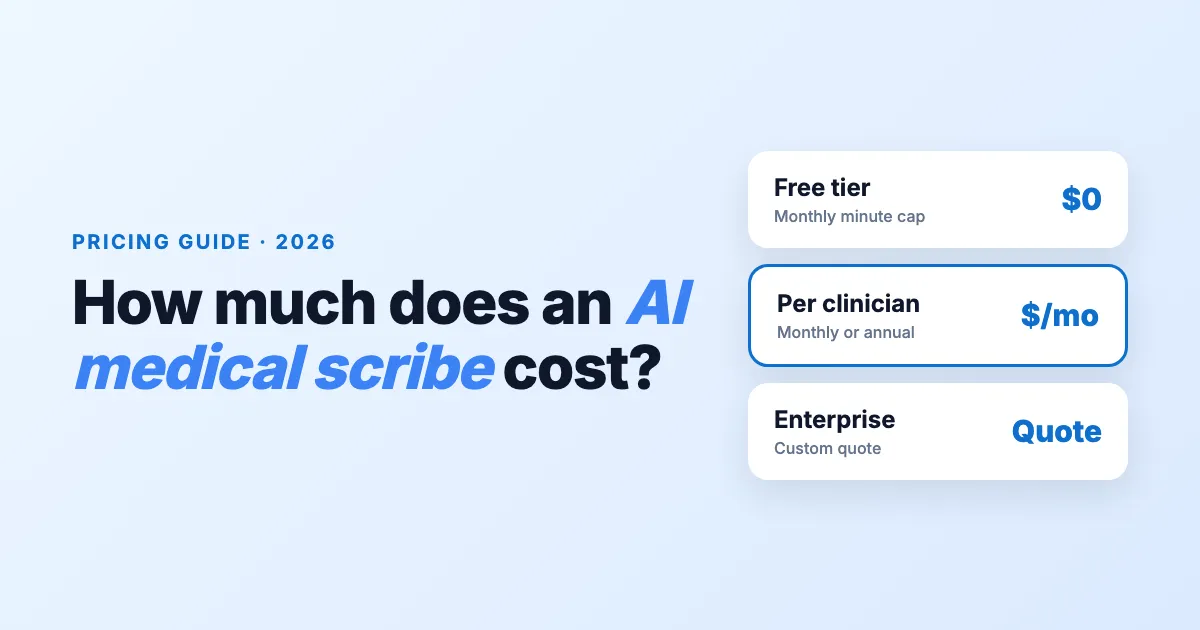
Compare plans and see full feature details at othisismedtech.com/pricing. The Basic plan starts at $149/month. Pro is $249/month with 15,000 minutes of transcription a month for up to 5 users.
Ambient clinical intelligence isn't science fiction. It's in practices across the US right now. The question is whether yours is one of them.
Disclaimer: Othisis Medtech is a documentation assistance tool designed to support clinical note generation. It is not a diagnostic tool, clinical decision support system, or substitute for physician judgment. All documentation generated by Othisis is reviewed and finalized by a licensed clinician prior to entry into the medical record. Othisis does not provide medical advice, clinical recommendations, or treatment guidance.
Ambient Clinical Intelligence Frequently Asked Questions (FAQs)
Reduced documentation burden
Less after-hours charting
Improved physician efficiency
Better patient engagement during visits
More accurate clinical documentation
Reduced administrative burnout