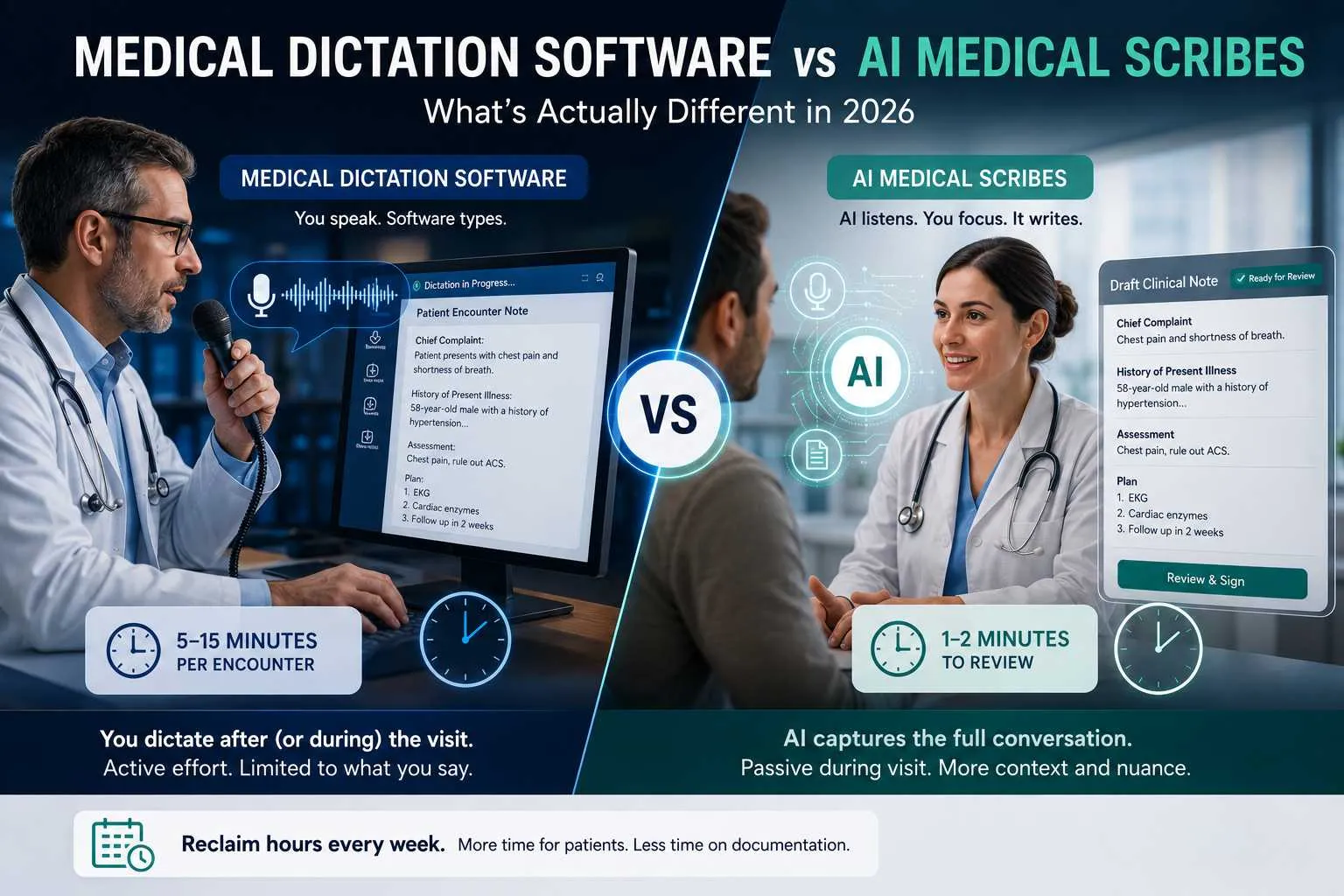
If you've been using Dragon Medical One or a similar medical dictation software, you've already accepted that documentation takes time you've just optimized how you spend that time. Speaking is faster than typing. Templates reduce repetition. Over time, the system learns your vocabulary and your shortcuts get sharper.
That's a real improvement over keyboard-only documentation. But it's still fundamentally the same workflow: the appointment ends, and then you reconstruct the encounter as a note. You're still the one producing the documentation. You're still the one spending time after or between patients to get it done.
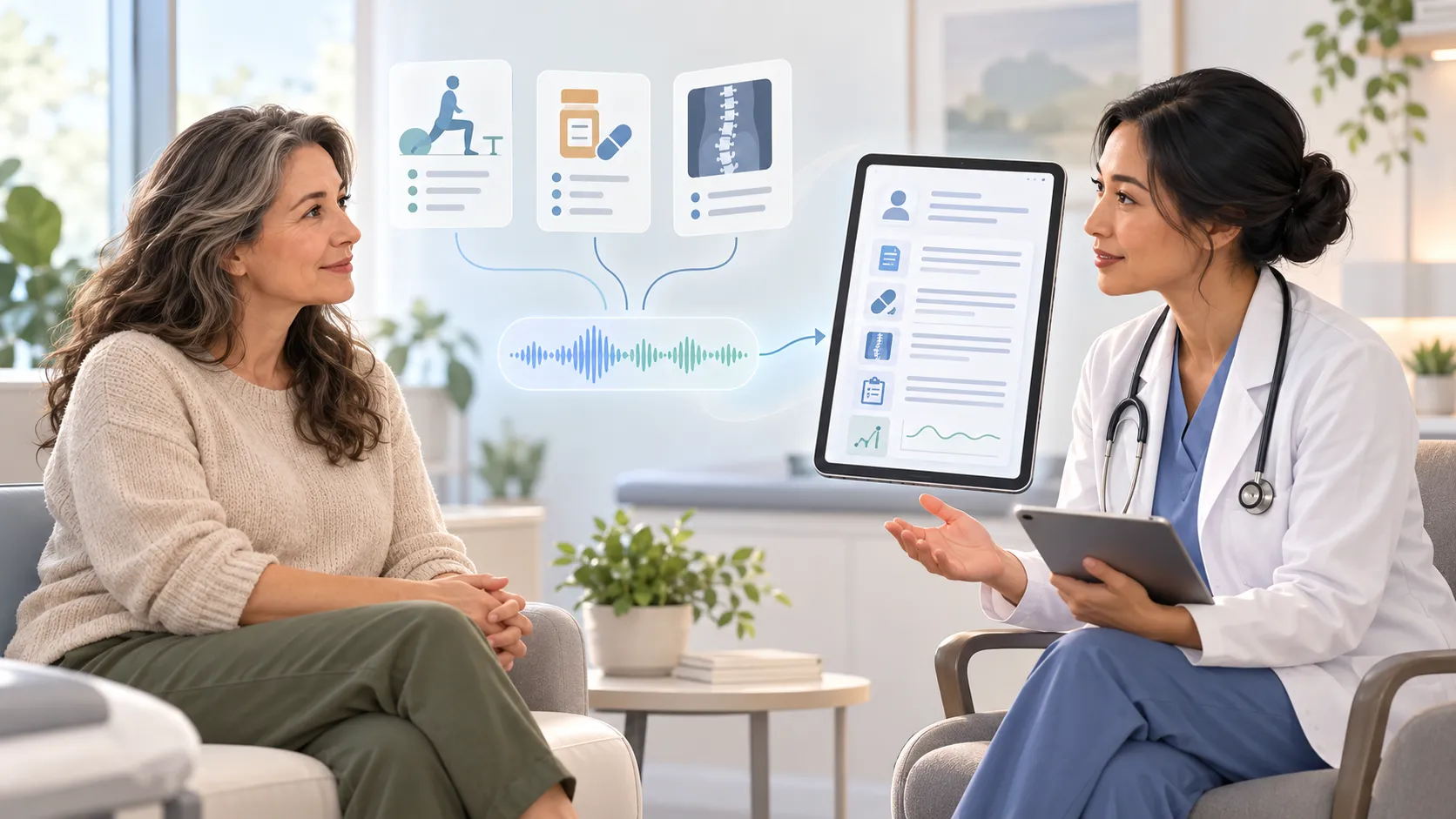
In 2026, there's a materially different option: ambient AI medical scribing. It doesn't ask you to dictate anything. It listens to the clinical encounter as it happens, then drafts the note automatically. The physician reviews, edits if needed, and signs. That's the workflow.
This post breaks down exactly what separates medical dictation software from ambient AI scribing not as a marketing comparison, but as a practical look at where each approach fits, what each costs in time and money, and what the actual differences are for a working clinician.
What Is Medical Dictation Software?
Medical dictation software converts spoken words into typed text in real time. The physician speaks — either during or after the clinical encounter — and the software transcribes the speech into a note, an order, or a structured field inside the EHR.
The category has been led for decades by Nuance Dragon Medical, now Dragon Medical One (cloud-based), along with competitors including Suki AI, MModal Fluency, and Notta Medical. These tools integrate with major EHR platforms and offer specialty-specific vocabularies, custom commands, and voice-activated navigation inside the EHR.
Medical dictation software is genuinely useful. Its advantages include:
- Speed over typing: Most physicians can speak at 120–150 words per minute significantly faster than touch-typing under clinical time pressure.
- Specialty vocabulary: Dragon Medical One and similar tools support extensive medical terminology, reducing transcription errors for complex clinical language.
- EHR navigation: Voice commands can open charts, navigate between fields, and trigger macros not just transcribe speech.
- Physician familiarity: Many clinicians have used dictation tools for years. The learning curve is low because the workflow is intuitive.
But medical dictation software has a ceiling and in 2026, that ceiling matters more than ever.
The core limitation: you still have to dictate.
Whether you dictate during the encounter (splitting your attention between the patient and the note) or after the encounter (adding time to your day), medical dictation software requires active physician input to produce documentation. The AI converts speech to text with high accuracy. But the physician still has to speak every word of the note.
How Ambient AI Scribing Is Different
Ambient AI medical scribing removes the dictation step entirely.
Othisis Medtech's AI medical scribe uses ambient listening technology to capture the clinical conversation as it naturally unfolds with explicit patient consent and then generates a structured clinical note from that conversation automatically. The physician doesn't narrate. The physician doesn't dictate. The physician simply sees the patient.
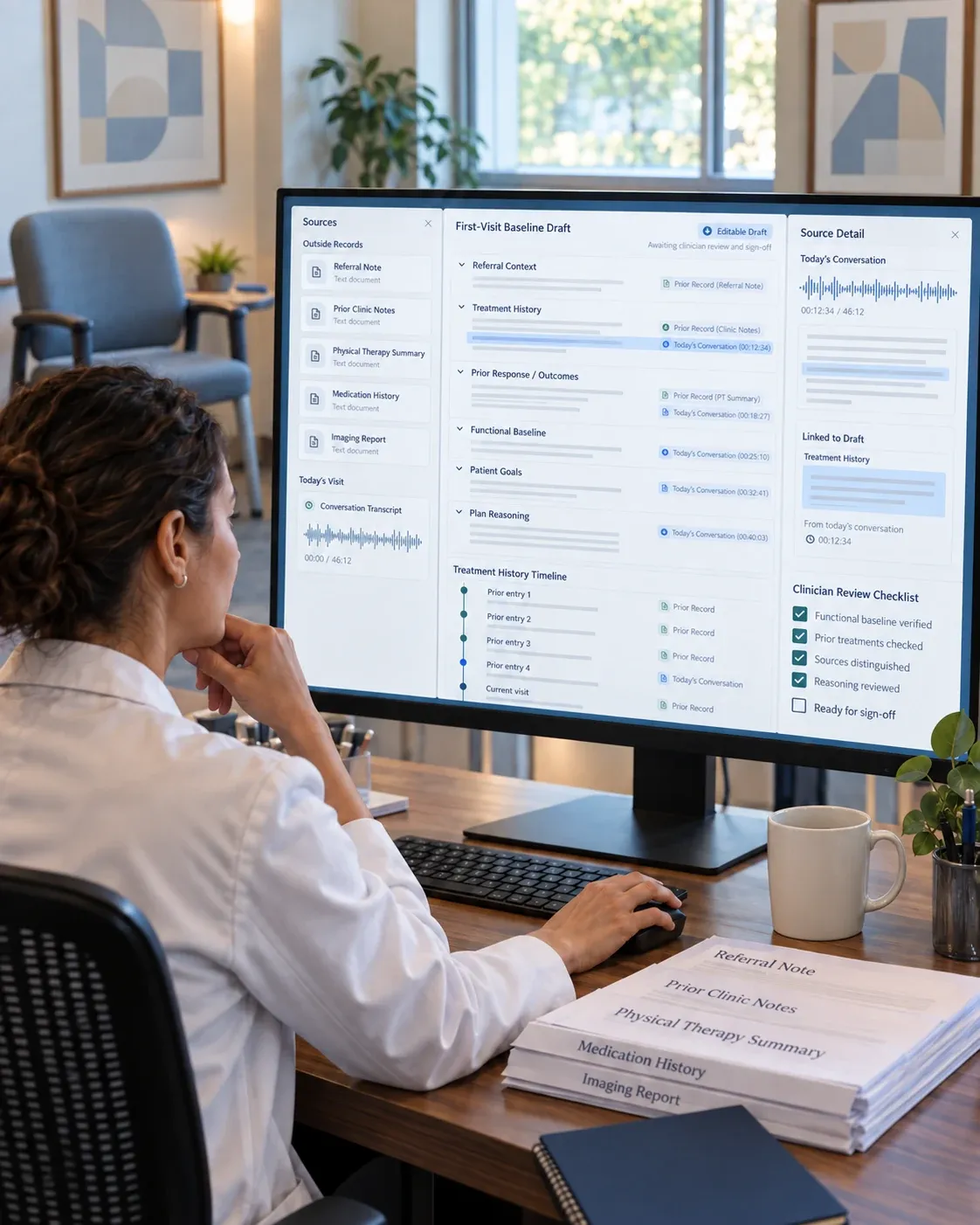
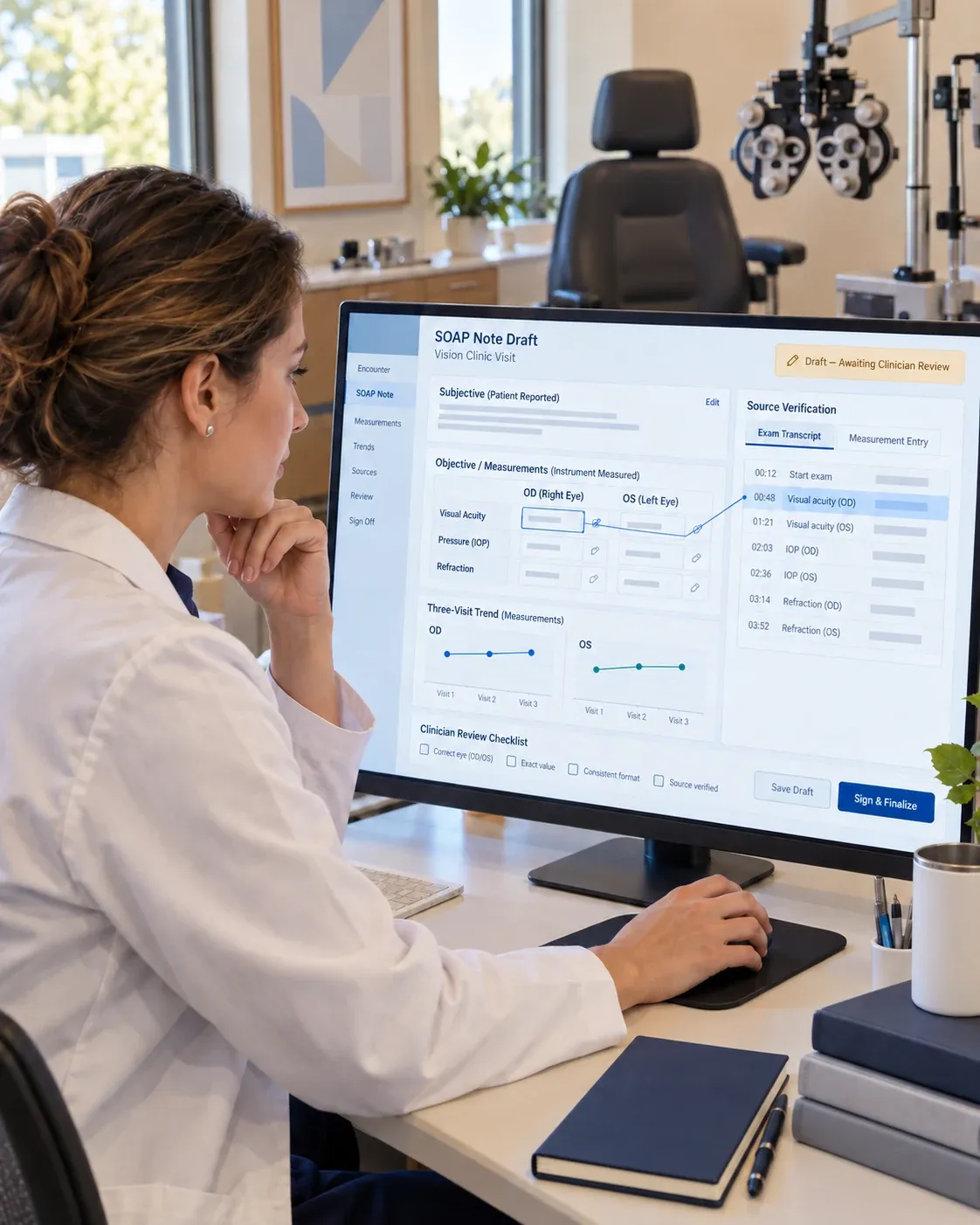
By the time the patient leaves the room, a draft note is waiting for review. The physician reads it, edits anything that needs adjusting, and signs. For most encounters, that review takes under two minutes.
The workflow difference is significant:
|
Step |
Medical Dictation Software |
Ambient AI Medical Scribe |
|
During encounter |
Physician may dictate or take notes |
Physician focuses entirely on the patient |
|
After encounter |
Physician dictates full note (5–15 min) |
Physician reviews AI draft (1–2 min) |
|
Note generation |
Physician's spoken words → text |
Conversation → structured clinical note |
|
Physician effort |
Active (speaking required) |
Passive during encounter, review after |
|
Missed content |
Whatever wasn't dictated |
Captured from full conversation |
The ambient model also captures clinical content that dictation-based workflows routinely lose: spontaneous patient disclosures, the nuanced back-and-forth of a complex history, the moment a patient mentions a symptom the physician didn't ask about directly. Because the full conversation is captured (not just what the physician chooses to speak into a microphone), the resulting note can be more complete and more accurate.
Side-by-Side Comparison: Medical Dictation Software vs AI Medical Scribe
|
Medical Dictation Software |
Ambient AI Medical Scribe (Othisis) |
|
|
How it works |
Converts physician's spoken words to text |
Listens to full encounter, generates structured note |
|
Time required |
5–15 min dictation per encounter |
1–2 min review per encounter |
|
Clinician effort |
High — active speaking required |
Low — passive during encounter |
|
Note completeness |
Limited to what physician narrates |
Captures full clinical conversation |
|
Accuracy |
High for speech-to-text; depends on physician dictation quality |
High; uses contextual NLP to interpret clinical dialogue |
|
HIPAA compliance |
Yes (with proper configuration) |
Yes, HIPAA-compliant infrastructure by design |
|
EHR integration |
Yes — most major EHR platforms |
Yes, maps to existing EHR note formats |
|
Cost |
Dragon Medical One: ~$99–$199/month per user |
Othisis: $149/month (Basic), $249/month (Pro) |
|
Setup time |
Hours to days (voice profile training) |
Minutes, no training required |
|
Best for |
Physicians who want faster typing, not full automation |
Physicians who want documentation removed from their workflow |
The Real Question: Where Does Your Time Go?
Choosing between medical dictation software and ambient AI scribing isn't just a feature comparison. It's a question about where physician time is actually going and where it should be going.
Medical dictation software optimizes the output side of documentation: it makes the note faster to produce once the physician starts producing it. But it doesn't remove the physician from the documentation process. It refines it.
Ambient AI scribing optimizes the input side: it removes the need for the physician to produce documentation at all during or after the encounter. The conversation is the input. The note is the output. The physician's role is review and sign-off.
Consider a typical primary care day: 20 patient encounters, averaging 15 minutes each. With medical dictation software, a physician might spend 5 minutes dictating per encounter after the visit — that's 100 minutes of dictation on top of clinical time. With ambient AI scribing, the same physician spends 2 minutes reviewing per encounter 40 minutes total, and most of that can happen between patients.
Over a five-day week, that difference compounds to 5+ hours reclaimed from documentation time that can go back to patients, to research, to the business of running a practice, or simply to finishing at a reasonable hour.
For physicians already paying $99–$199/month for Dragon Medical One, the cost difference to move to ambient AI scribing is either comparable or modest. The workflow difference, however, is not modest.
Which Is Right for Your Practice?
Medical dictation software may be the better fit if:
- You prefer dictating notes in real time and have a workflow built around it
- You need deep EHR navigation via voice commands (ordering, chart navigation)
- You see a low daily patient volume where the dictation overhead is manageable
- Your specialty involves highly formulaic notes where templated dictation works well
Ambient AI scribing may be the better fit if:
- You're spending more than 60–90 minutes daily on documentation after clinic hours
- You want to be fully present with patients without splitting attention to a microphone
- Your encounters involve complex, non-linear conversations that are hard to capture post-hoc
- You want to reduce documentation burden without adding a new manual step to your workflow
The clinicians who switch from medical dictation software to ambient AI scribing most often report the same thing: they didn't realize how much cognitive overhead the dictation step carried until it was gone. Reconstructing an encounter from memory even through dictation requires sustained mental effort. Reviewing a draft note requires far less.
Othisis: Ambient AI Scribing Built for Working Clinicians
Othisis Medtech was built on a straightforward premise: physicians shouldn't have to choose between being present with their patients and having complete, accurate documentation.
Unlike medical dictation software, Othisis doesn't ask anything of you during the encounter. It listens, it understands clinical context, and it drafts. You review. You sign. You move on.
The "glass box, not black box" design means every note is fully transparent you can see what was captured, understand how the note was structured, and edit freely before sign-off. There are no hidden AI decisions in your clinical record.
Othisis is not a diagnostic tool, a clinical decision support system, or a replacement for physician judgment. It is a documentation tool designed to handle the documentation so you can focus on the medicine.
Setup takes under five minutes. No voice profile training. No new hardware. Works with your existing EHR and your existing workflow.
Try It Free - No Card, No Commitment
If you're currently using medical dictation software and spending more than an hour a day on post-visit documentation, it's worth seeing what an ambient AI approach actually feels like in practice.
Try Othisis for Free — No Card Required →
The free Starter plan lets you run real encounters and see actual note output before you commit to anything. The Basic plan ($149/month) and Pro plan ($249/month) scale with your practice volume and integration needs.
See full plan details at othisismedtech.com/pricing.
Your workflow doesn't have to include dictation. Let the AI do the listening.
Othisis Medtech is a documentation assistance tool. It does not provide clinical recommendations, diagnostic support, or treatment guidance. All notes are reviewed and signed by the licensed clinician