The Documentation Crisis in Modern Medicine
Dr. Sarah Chen finishes seeing her last patient at 4:30 PM. Instead of heading home, she spends the next 45 minutes reviewing referral letters, lab reports, imaging studies, and previous consultation notes before completing documentation.
For many clinicians, this has become a daily routine.
Patient information is often scattered across multiple systems, hospitals, and specialists. Before every visit, clinicians must manually piece together a patient’s medical history from PDFs, scanned records, discharge summaries, referrals, and prior notes. This administrative burden reduces valuable patient-facing time and contributes to after-hours documentation.
Medical record summarization powered by AI is changing that workflow.
What Is AI-Powered Medical Record Summarization?
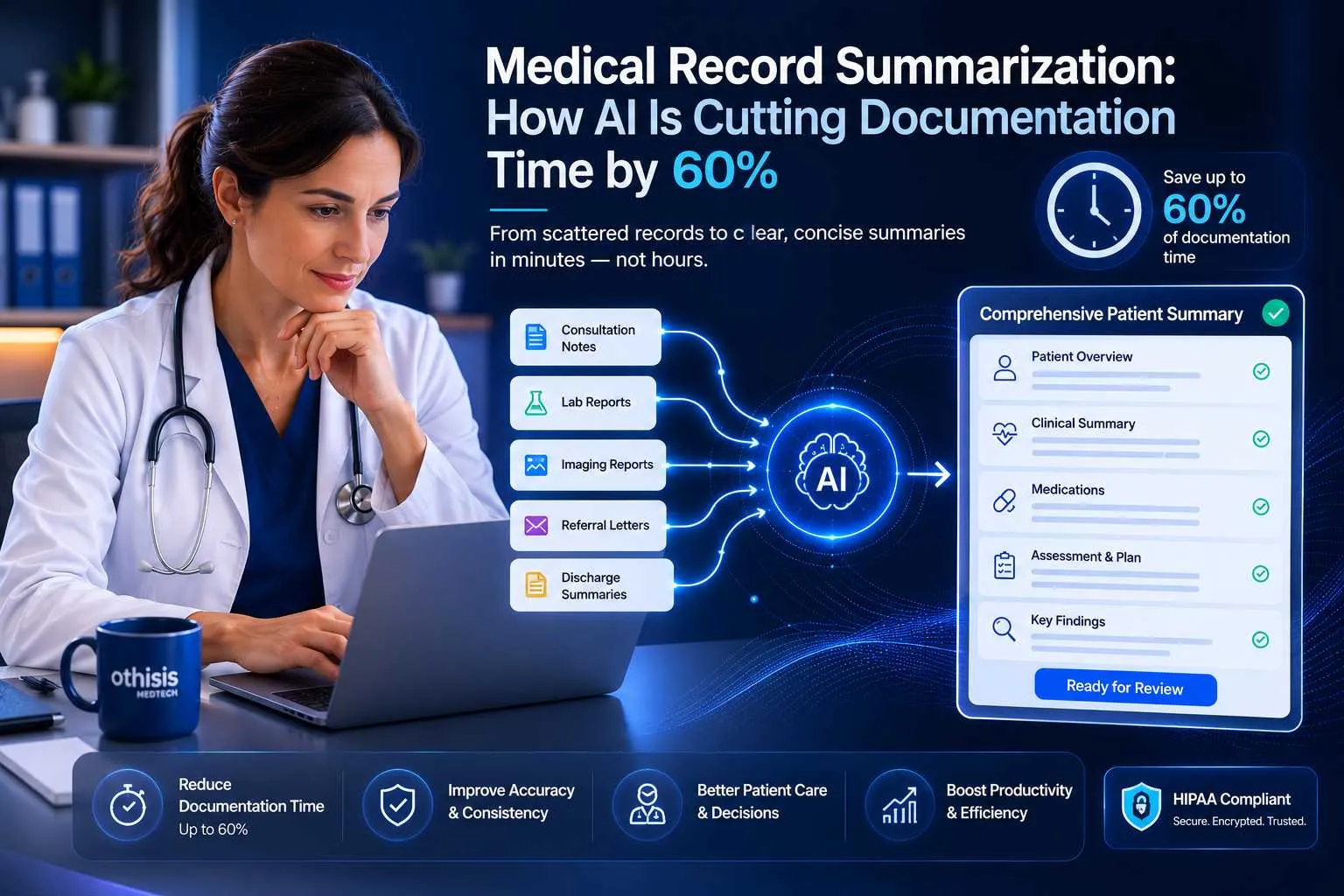
Medical record summarization uses artificial intelligence to extract clinically relevant information from multiple patient records and organize it into a concise, structured summary for clinician review.
Instead of manually reading dozens of pages before every appointment, clinicians receive a clear overview of the patient’s history while maintaining full control over clinical decisions.
Traditional workflow:
• Open multiple referral letters and consultation notes
• Review laboratory and imaging reports
• Identify relevant diagnoses, medications, allergies, and prior treatments
• Manually create a clinical summary
• Begin documentation
AI-assisted workflow:
• Upload referral letters, PDFs, scans, and medical records
• AI extracts and organizes clinically relevant information
• Clinician reviews a structured summary
• Approved information becomes the foundation for clinical documentation
The goal isn’t to replace clinician judgment it’s to eliminate repetitive administrative work.
Why Medical Record Summarization Has Become So Difficult
Healthcare has become increasingly fragmented.
A single patient may receive care from multiple physicians, hospitals, imaging centers, and laboratories. Every new encounter generates another document that must be reviewed before the next visit.
Common records clinicians review include:
- Referral letters
- Previous consultation notes
- Hospital discharge summaries
- Laboratory reports
- Imaging reports
- Insurance documentation
- External PDFs and scanned records
Reviewing these documents manually requires significant time and constant context switching before patient care even begins.
How Othisis Approaches Medical Record Summarization
Othisis was built to simplify one of the most time-consuming parts of clinical documentation: reviewing and understanding historical patient records.
Instead of reading multiple documents individually, clinicians upload medical records into Othisis, where AI organizes the information into a structured clinical summary for review.
The platform can process:
- Referral letters
- Previous consultation notes
- Laboratory reports
- Imaging reports
- Hospital discharge summaries
- External PDFs
- Scanned medical records
Rather than presenting pages of unorganized text, Othisis highlights clinically relevant information so clinicians can understand a patient’s history in minutes instead of manually reviewing every document.
Confidence Before Summarization
Not every medical record arrives in perfect digital format.
Many referrals, older medical records, and scanned documents require optical character recognition (OCR) before they can be summarized.
Othisis allows clinicians to review document extraction quality before generating the final summary. This additional review step helps ensure that AI is working from accurately extracted clinical information, providing greater transparency for complex or scanned records.
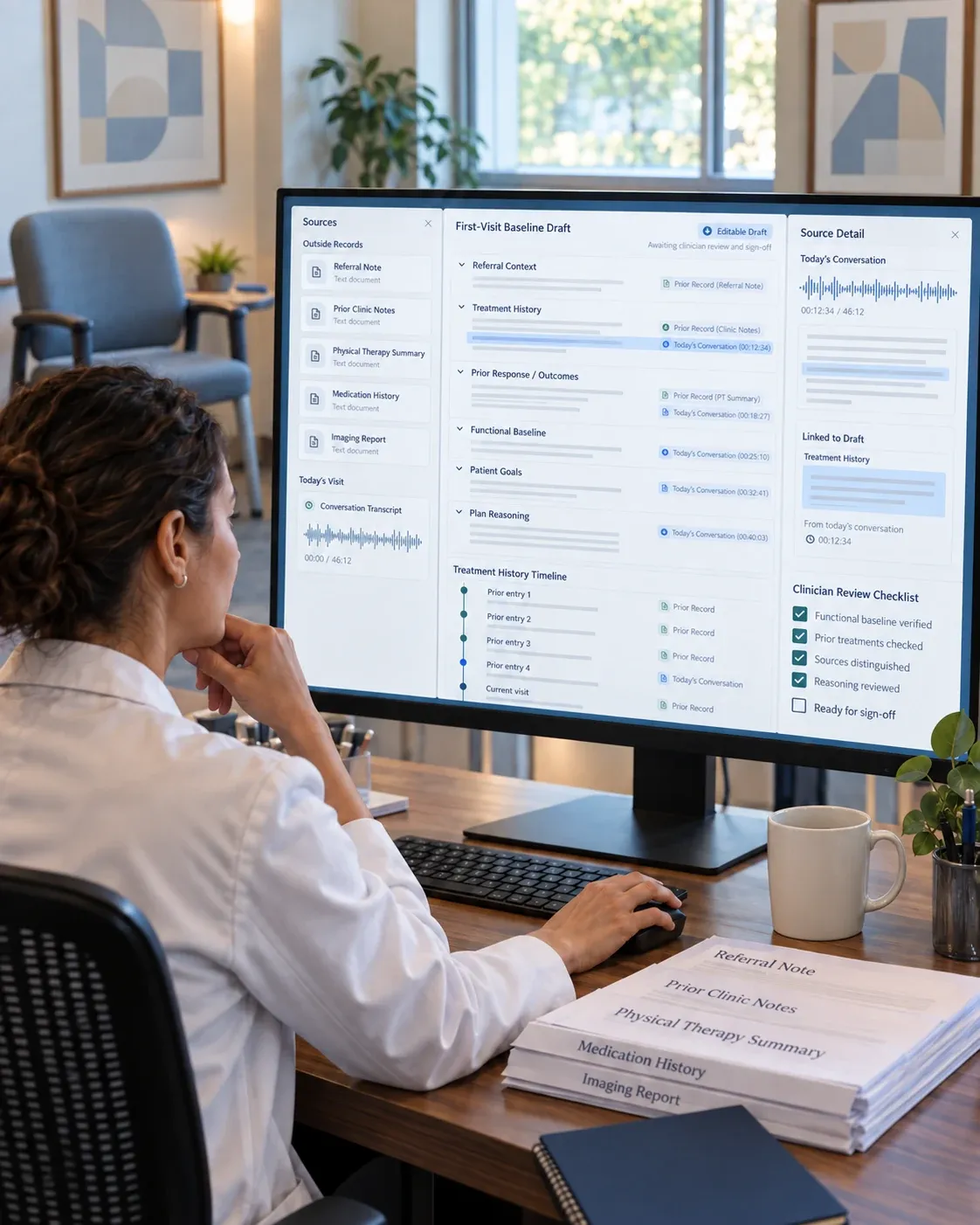
Every Summary Is Fully Traceable
Trust is essential in healthcare.
One of the biggest concerns clinicians have with AI-generated summaries is understanding where information originated.
Othisis addresses this through source traceability.
Every important clinical finding can be linked back to its original document, allowing clinicians to verify information quickly without manually searching through multiple PDFs.
Whether information comes from:
- A referral letter
- A laboratory report
- An imaging study
- A previous consultation note
- A hospital discharge summary
Clinicians can review the original source whenever needed before using that information in patient care.
This keeps clinicians in control while increasing confidence in AI-assisted documentation.
From Medical Records to Clinical Documentation
Medical record summarization is only the first step.
Once clinicians approve the summarized patient history, Othisis uses that verified clinical context throughout the documentation workflow.
Following the patient visit, clinicians can generate:
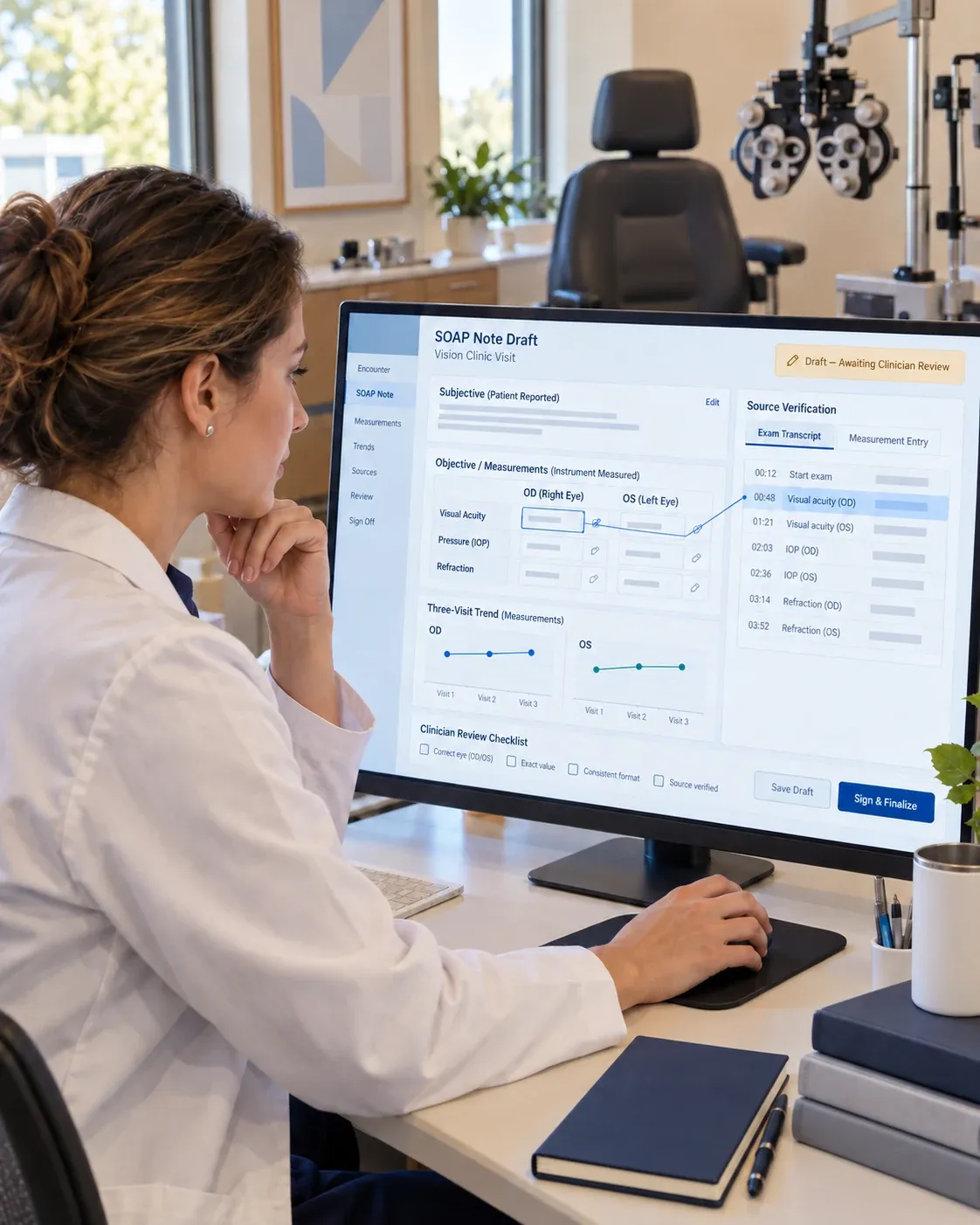
- SOAP Notes
- Referral Letters
- Insurance Documentation
- Patient Handouts
- Visit Summaries
Because documentation is generated using both the patient’s historical medical records and the clinician-patient conversation, clinicians no longer need to repeatedly reference multiple documents throughout the visit.
Ambient AI Scribe Meets Medical Record Summarization
Most AI documentation platforms focus on either transcription or document summarization.
Othisis combines both into a single workflow.
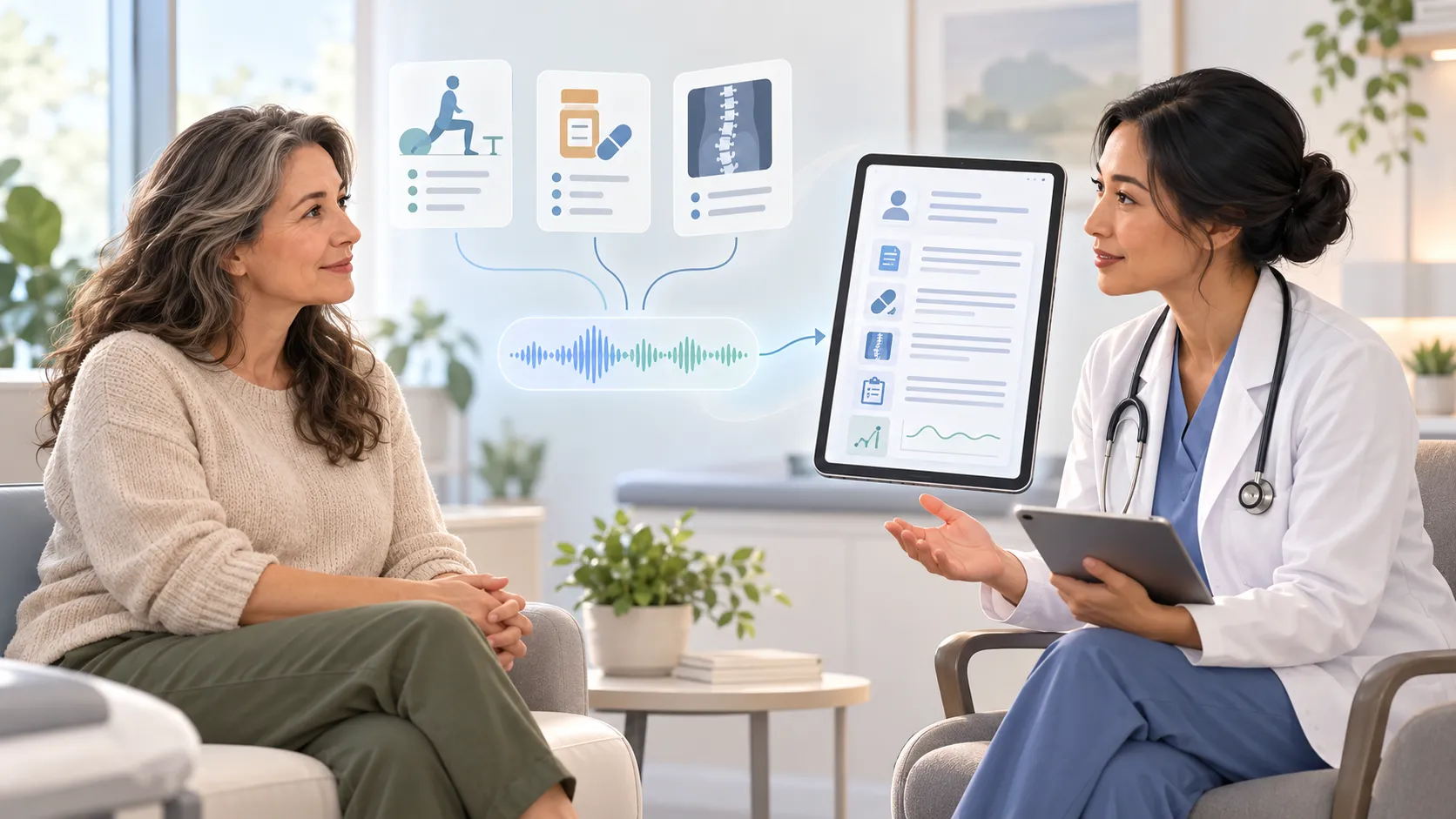
Before the visit
Medical records are summarized into a structured patient overview.
During the visit
The ambient AI medical scribe captures the clinician-patient conversation.
After the visit
Both information sources are combined to generate clinical documentation that reflects the patient’s historical records alongside today’s encounter.
This unified workflow reduces duplicate work while helping clinicians maintain complete clinical context throughout the visit.
Benefits of AI Medical Record Summarization
Faster Patient Preparation
Instead of manually reviewing multiple documents before each appointment, clinicians begin the visit with an organized summary of the patient’s relevant medical history fully traced back to the source.
Reduced Administrative Burden
Less time spent searching through referral letters and PDFs means more time available for patient care and clinical decision-making.
Better Clinical Context
Relevant diagnoses, medications, allergies, laboratory findings, and imaging reports are organized into one structured view, making complex cases easier to understand.
Improved Documentation Workflow
Summarized medical records become the foundation for documentation generated after the patient visit, reducing repetitive data entry across multiple documents.
Greater Transparency
Source traceability allows clinicians to verify important findings by returning directly to the original medical record whenever needed.
Specialty Applications
Medical record summarization benefits nearly every specialty, particularly those managing patients with extensive clinical histories.
Primary Care
Consolidate referrals, specialist notes, laboratory reports, and imaging before complex visits.
Cardiology
Review previous procedures, imaging studies, medications, and laboratory trends without manually searching multiple records.
Oncology
Organize pathology reports, treatment history, imaging, and specialist consultations into a structured timeline.
Orthopedics
Summarize surgical history, imaging findings, rehabilitation notes, and previous consultations.
Psychiatry
Review prior diagnoses, medication history, treatment plans, and behavioral health records before each appointment.
Compliance and Security
Medical record summarization involves highly sensitive patient information.
Othisis was built with healthcare security and compliance in mind.
Features include:
- HIPAA-compliant infrastructure
- End-to-end encryption
- Business Associate Agreements (BAAs)
- Audit logging
- Role-based access controls
- Source traceability
- Clinician review before final documentation
Patient information remains protected while giving clinicians confidence in every stage of the documentation workflow.
Getting Started with AI Medical Record Summarization
Step 1
Identify patient encounters that require reviewing multiple referral letters, consultation notes, or external records.
Step 2
Upload medical records into Othisis to generate a structured patient summary.
Step 3
Review and verify the summarized information using built-in source traceability.
Step 4
Use the approved summary to support documentation generated after the patient visit.
The Future of Clinical Documentation
Medical record summarization isn’t about replacing clinical expertise.
It’s about giving clinicians immediate access to organized patient history without spending valuable time searching through disconnected records.
As healthcare data continues to grow, clinicians need tools that reduce administrative burden while maintaining transparency, security, and clinical oversight.
By combining AI-powered medical record summarization with an ambient AI medical scribe, Othisis helps clinicians move from fragmented documentation to a single, connected workflow from patient records to completed clinical notes.
Why Othisis Is Different
Many AI documentation platforms focus on only one part of the documentation process.
Some summarize PDFs.
Others transcribe patient conversations.
Othisis brings both together.
Before the visit, Othisis organizes historical medical records into a structured, traceable clinical summary. During the visit, the ambient AI medical scribe captures the clinician-patient conversation. After the visit, both sources work together to generate documentation such as SOAP notes, referral letters, insurance documentation, patient handouts, and visit summaries.
Instead of managing multiple disconnected workflows, clinicians work from a single platform designed to simplify documentation while keeping them in complete control of every clinical decision.
Ready to Simplify Medical Record Summarization?
If your practice spends hours every week reviewing referral letters, consultation notes, laboratory reports, and external PDFs before patient visits, AI-powered medical record summarization can help streamline that process.
See how Othisis transforms fragmented patient records into structured clinical context that powers the entire documentation workflow from medical record summarization to ambient AI scribing and completed clinical documentation.