
The Direct Answer
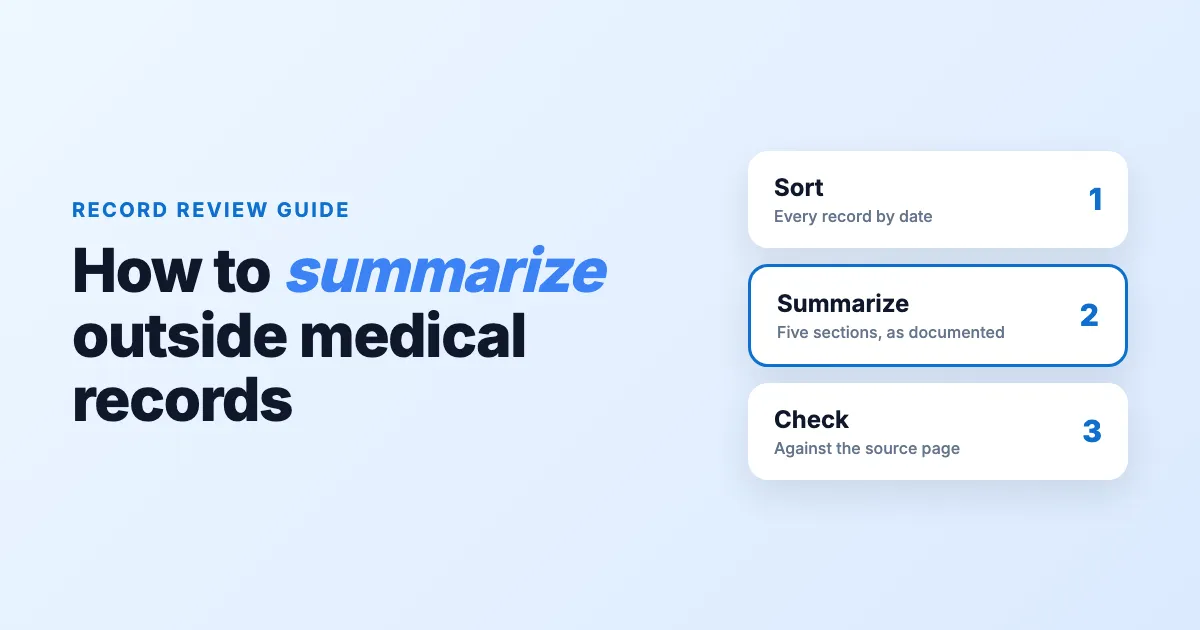
To summarize outside medical records before a new-patient visit, read the records in date order and pull what they document into five parts: a short narrative of why the patient is coming to you, a dated timeline of care, the problems and diagnoses the treating providers recorded, the current medication list, and tables of vitals and key results. Write down only what the records say, note who said it, and mark anything unclear instead of guessing.
Below is a step-by-step method you can use by hand, a one-page template, and how an AI summarization tool can draft the same summary for you to check.
Why Summarize Outside Records First
- Records arrive as PDFs. Referral letters, discharge summaries, consult notes and lab reports often come as long scanned files with repeated pages.
- The visit is short. Reading every page during the appointment takes time away from the patient.
- Details hide in the middle. A medication change or a recent result can sit on page 20 of a 40-page file.
Step-by-Step: How to Summarize Medical Records
- Sort by date. Put every document in order by the date of service, not the date it was received. Note any document with no date.
- Skim for the reason for referral. Find the referral letter or most recent note and write one or two sentences on why the patient is being seen.
- Build the timeline. For each visit, admission, procedure or consult, write the date, what happened and the documented outcome. Merge duplicate updates into one entry.
- List documented problems. Copy the working diagnoses and differentials the treating providers wrote. Do not add your own at this stage.
- List medications. Write each medication with its dose and its status as documented (started, continued, changed, stopped).
- Tabulate vitals and results. Put vitals and key labs or imaging reports in a small table with the date of each.
- Flag what is unclear. If a page is illegible or two documents disagree, write "Record unclear regarding" and the item, so you can ask the patient.
A One-Page Template
| Section | What goes in it |
|---|---|
| 1. Summary | Age, sex and the documented reason for the visit, in a short paragraph |
| 2. Timeline of care | Date and time, event, documented outcome, in date order |
| 3. Documented problems | Diagnoses and differentials as written by the treating providers |
| 4. Medications | Name, dose and documented status |
| 5. Vitals and results | Tables of vitals and key labs or imaging reports, with dates |
Rules That Keep the Summary Accurate
- Report, don't interpret. Write "Notes indicate" or "Patient reports" rather than stating a condition as fact.
- Use written reports, not images. If a record has an image with no written report, note that it is present without a written interpretation.
- Don't guess dates or values. Leave them blank and mark them unclear.
- Keep the source. Note the document and page for each item so you can find it again in the visit.
Using AI to Draft the Summary
An AI summarization tool can read the uploaded PDFs and draft the same five sections, so you start from a structured draft instead of a stack of pages. What matters is that you can check it quickly:
- Source links. Each point in the summary should link back to the page in the original PDF it came from.
- Text conversion confidence. Scans and faxes don't always convert cleanly. A confidence score on the PDF-to-text step tells you which parts to double-check against the original.
- No added conclusions. The summary should report what the records document, without adding diagnoses or treatment suggestions.
- Your review. You read and edit the summary before relying on it.
How Othisis Does It
With Othisis PDF Upload, you upload outside records before the visit. Othisis converts them to text, shows a confidence score for that conversion, and drafts a summary in date order with the documented problems, medications, and vitals and results. Every summary point links to the exact place in the source PDF. When the visit starts, the AI scribe drafts the visit note, and you review everything before you sign. Learn more about medical record summarization.
The free Starter plan includes 25 PDF pages and 180 minutes of transcription a month, with no credit card. Start free or book a live demo.
Othisis is a clinical documentation tool. It does not make clinical decisions, provide diagnoses or offer medical advice.