
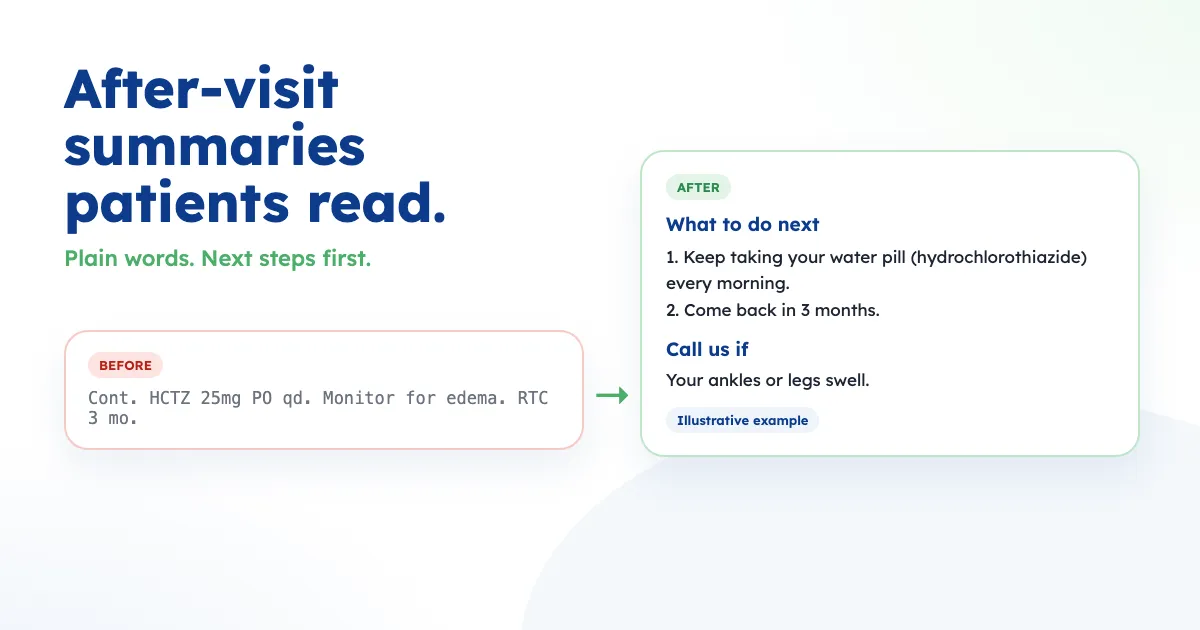
Patients forget much of what they hear in a visit. A review in the Journal of the Royal Society of Medicine estimated that 40 to 80 percent of medical information patients are given is forgotten immediately (Kessels, 2003). A good after-visit summary is what they come back to. This guide covers the structure that works, how to write at a level patients can follow, how to make next steps unmistakable, and how to check understanding before the patient leaves.
The Short Answer
An after-visit summary is a one-page, plain-language note a patient takes home. The ones patients read put next steps first, use everyday words, give each instruction a number and a time, and say exactly when to call. Pair it with a quick teach-back in the room and it does far more than a printout of the note.
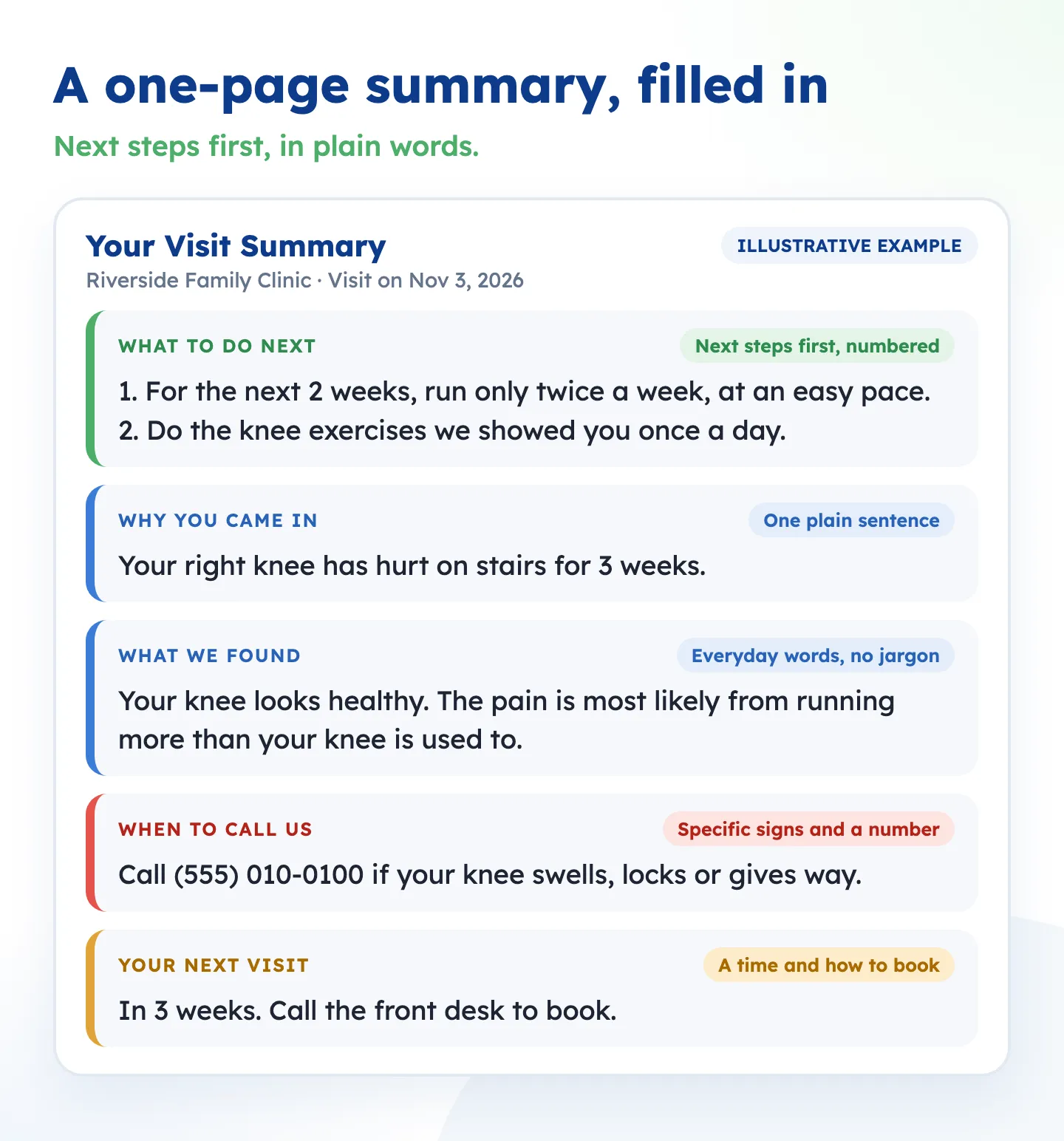
A Structure That Works
| Section | What goes in it |
|---|---|
| What to do next | Numbered steps, each with an action and a time: medicines as discussed, tests, exercises, appointments |
| Why you came in | One sentence in the patient's words |
| What we found | A short, plain summary of what the clinician explained |
| When to call us | The specific warning signs the clinician gave, and the number to call, including after hours |
| Your next visit | Date or timeframe, and who to contact to book it |
Putting next steps first breaks the order of the visit note on purpose: it's the part patients look for.
Write at a Level Patients Can Follow
Health literacy guidance commonly recommends writing patient materials at about a sixth- to eighth-grade reading level, yet most patient materials are written well above it (study of 2,585 patient materials). Short sentences and everyday words do most of the work:
| Instead of | Write |
|---|---|
| Hypertension | High blood pressure |
| Take one tablet PO BID | Take 1 pill by mouth, morning and evening |
| PRN | Only when you need it |
| NPO after midnight | Don't eat or drink anything after midnight |
| RTC in 3 months | Come back in 3 months |
| Monitor for edema | Call us if your ankles or legs swell |
Make Every Next Step Unmistakable
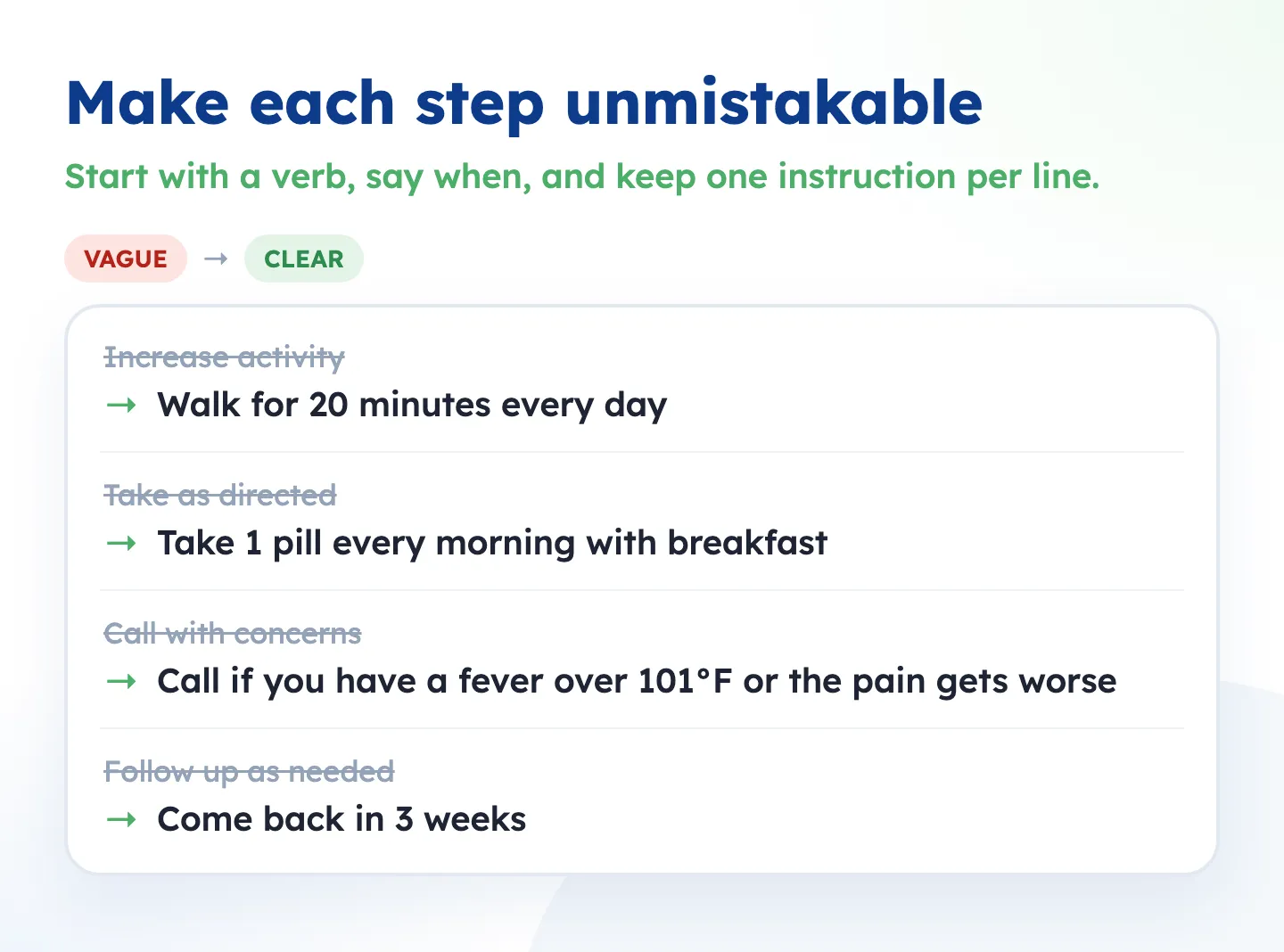
- Start each step with a verb and include the when: "Walk for 20 minutes every day", not "increase activity".
- One instruction per line. Combining steps is where patients lose one.
- Medicines exactly as discussed. Name, when to take it, and what changed today. The summary should match what the clinician told the patient, not add new advice.
- Specific warning signs. "Call if you have a fever over 101°F or the pain gets worse" works better than "call with concerns".
Check Understanding With Teach-Back
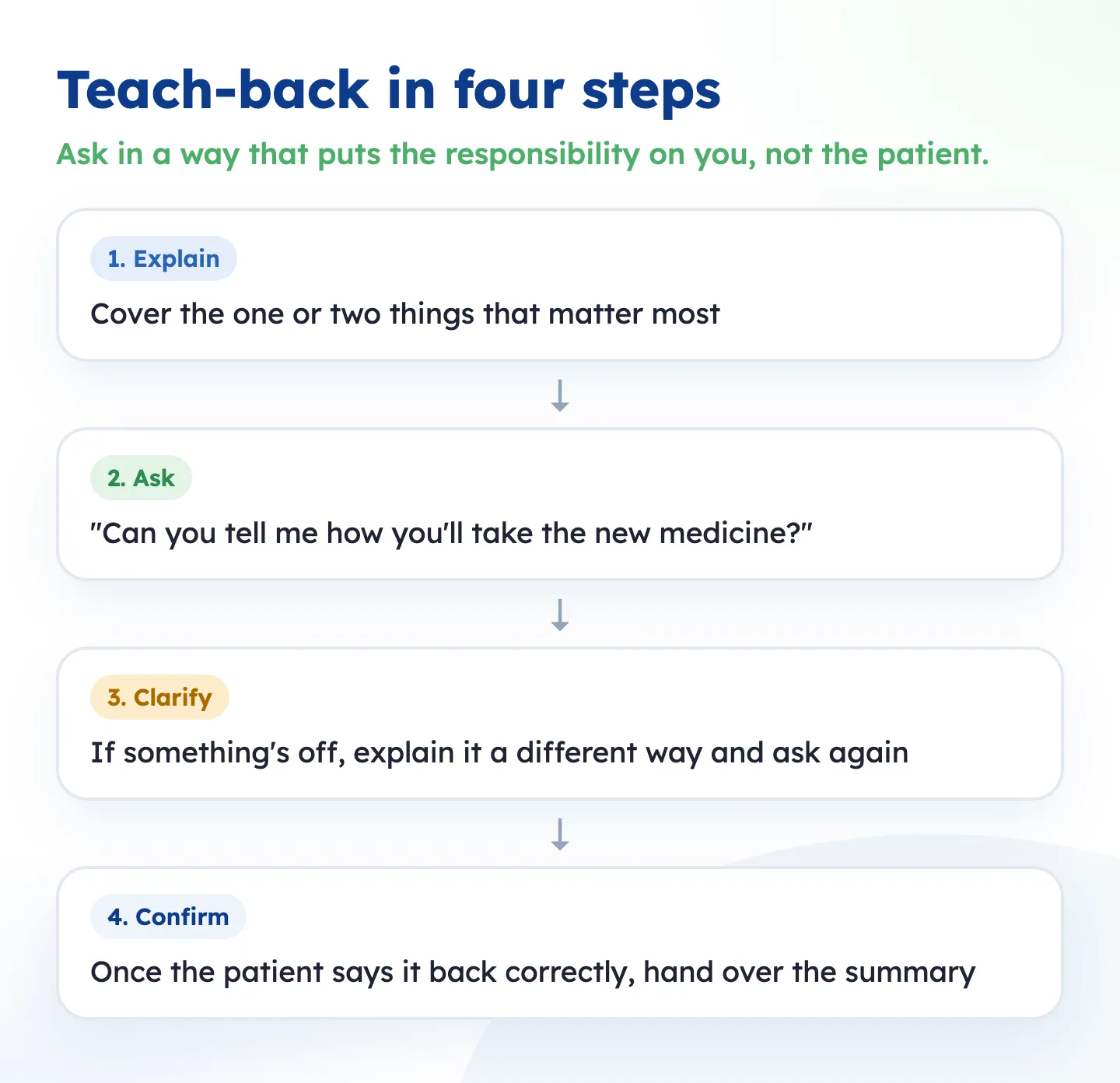
Teach-back means asking the patient to explain, in their own words, what they need to do, and clarifying anything they get wrong. It's a core tool in AHRQ's Health Literacy Universal Precautions Toolkit, which recommends assuming any patient may misunderstand (AHRQ toolkit, AHRQ teach-back). Use it for the one or two things that matter most, usually medicines and when to call:
- Ask in a way that puts the responsibility on you: "I want to be sure I explained this well. Can you tell me how you'll take the new medicine?"
- If something is off, explain it differently and ask again.
- Hand over the summary after teach-back, so it confirms what the patient just said back.
Format for Real Life
- One page if possible, with headings and plenty of white space.
- Large enough type to read without glasses where you can.
- Write for the caregiver too: they often manage the follow-up and weren't in the room.
- Offer the summary in the patient's preferred language when you can.
Checklist Before You Hand It Over
- Next steps come first, numbered, each with a time.
- Medicine changes match what was discussed.
- Warning signs are specific, with a number to call.
- The follow-up date or timeframe is there.
- Jargon and abbreviations are gone.
- The clinician has reviewed it, and teach-back is done.
Drafting Summaries From the Visit
Writing a separate summary for every patient takes time at the end of a busy day. In Othisis, after you approve the visit note you can add a patient handout: a plain-language summary, written at about a sixth-grade reading level and drafted from what was said in the visit. If a medicine or number wasn't clear in the recording, Othisis leaves it out of the handout and flags it for you to check. You review, edit and approve the handout before exporting it as a PDF to share. Learn more about patient handouts.
Othisis is a clinical documentation tool. It does not make clinical decisions, provide diagnoses or offer medical advice.