
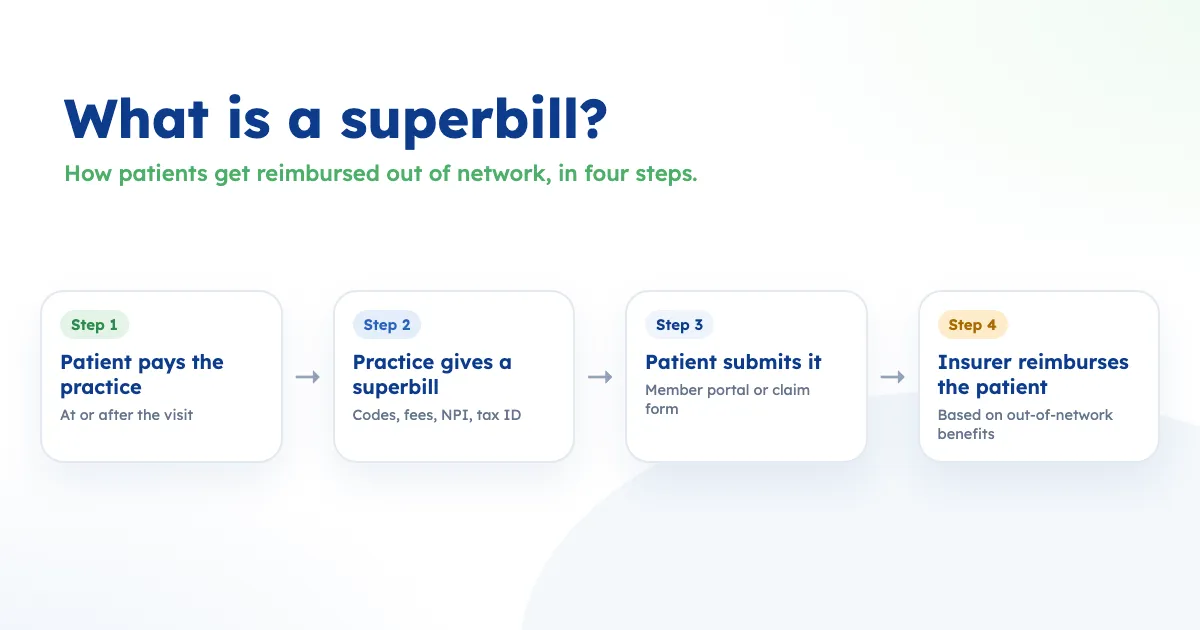
Cash-pay and out-of-network practices hand out superbills every day, and patients still come back with the same questions: what do I do with this, and why did my insurer send it back? This guide covers what a superbill has to contain, how out-of-network reimbursement actually works for the patient, the Good Faith Estimate rules that apply to self-pay patients, and the mistakes that get superbills rejected.
The Short Answer
A superbill is an itemized statement a practice gives a patient for a visit the patient paid for directly. It lists the provider, the date and place of service, diagnosis codes, the services provided with their codes and fees, and what was paid. A patient with out-of-network benefits submits it to their insurer to ask for partial reimbursement. The practice provides the document; the patient files the claim.
Superbill, Invoice or Claim?
| Invoice | Superbill | Insurance claim | |
|---|---|---|---|
| Purpose | Asks the patient to pay | Documents a paid visit so the patient can seek reimbursement | Asks the insurer to pay |
| Who sends it | Practice to patient | Practice to patient, then patient to insurer | Usually the practice, sometimes the patient |
| Codes | Optional | Diagnosis and service codes | Diagnosis and service codes on a standard form |
What a Superbill Must Include
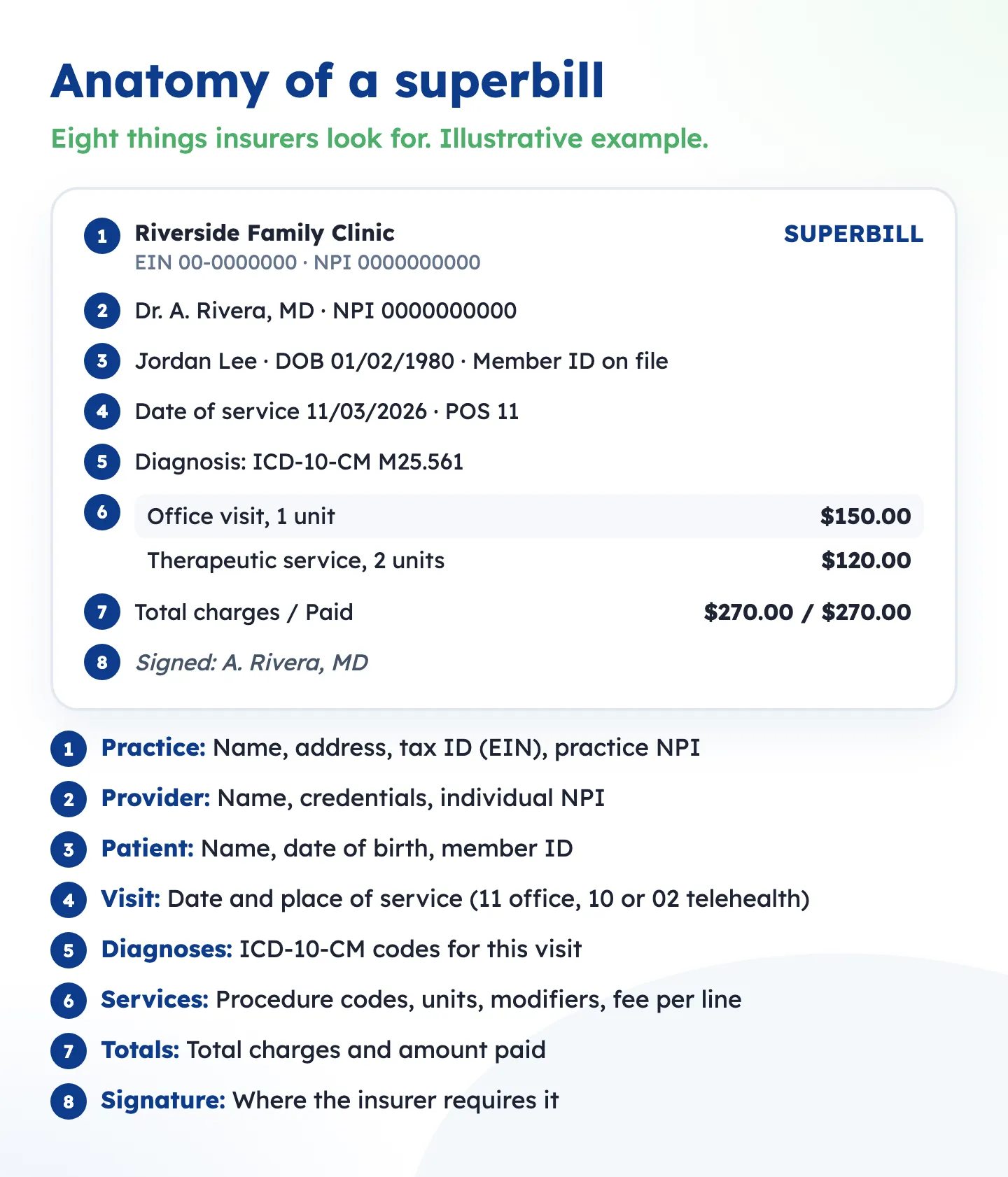
- Practice: name, address, phone and tax ID (EIN), plus the practice NPI if it has one.
- Rendering provider: name, credentials and individual NPI, and license number where relevant.
- Patient: name, date of birth, address and, if the patient shares it, insurance member ID.
- Visit: date of service and place of service. Common place of service codes include 11 for an office visit, and 10 or 02 for telehealth in or outside the patient's home (CMS place of service codes).
- Diagnoses: ICD-10-CM codes for the conditions addressed at that visit.
- Services: a procedure code for each service, with units, any modifiers, and the fee for each line.
- Totals: total charges and the amount the patient paid.
- Signature: the provider's signature, where the insurer requires it.
How Out-of-Network Reimbursement Works for the Patient
- Check benefits first. The patient asks their plan about out-of-network coverage, the deductible, coinsurance and the plan's allowed amount for the service. Reimbursement is usually a share of the allowed amount, not of what you charged.
- Get the superbill. After each visit, or once a month with every date of service listed.
- Submit it the plan's way. Most plans take uploads through the member portal; some want their own claim form or a CMS-1500 with it.
- Watch the deadline. Each plan sets its own filing limit, and claims sent late are usually denied, so encourage patients to submit promptly.
- Read the explanation of benefits. If the claim is denied, the reason on the EOB usually points to a missing field or a coverage limit.
Be clear with patients that the practice can't promise what the insurer will reimburse.
Self-Pay Patients and Good Faith Estimates
Under the No Surprises Act, providers must give uninsured and self-pay patients a Good Faith Estimate of expected charges when a service is scheduled at least three business days in advance, or when the patient asks for one, and patients can start a dispute process if the final bill is substantially higher than the estimate (CMS). For a cash-pay practice, that means:
- Ask whether the patient has coverage they plan to use, and tell self-pay patients an estimate is available.
- Base estimates on your fee schedule, so the estimate, the invoice and the superbill all use the same prices.
- Check CMS's No Surprises Act pages for current requirements, since CMS has issued several updates on how the rules are enforced.
Why Superbills Get Sent Back
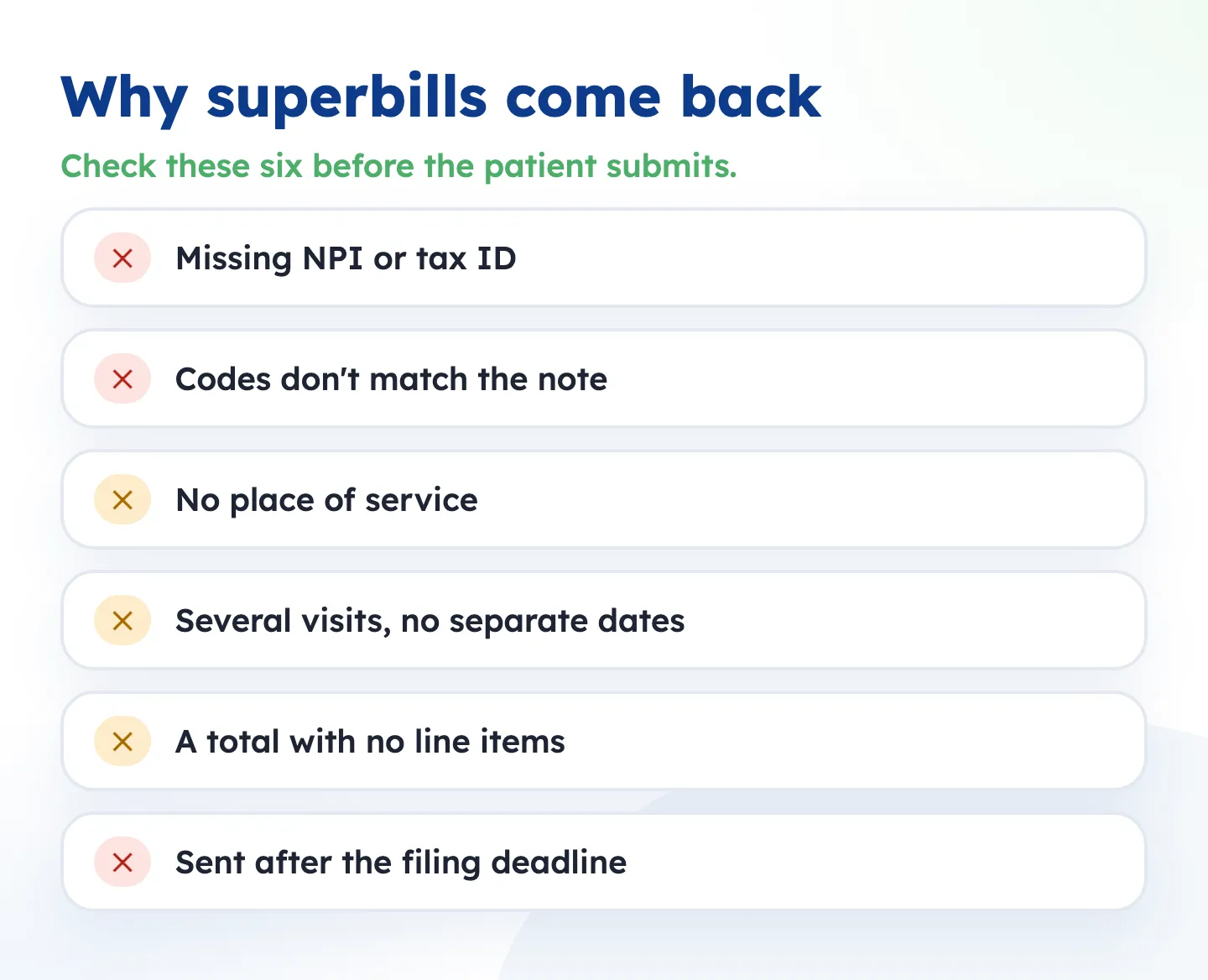
- Missing NPI or tax ID. Insurers often can't process the claim without them.
- Codes that don't match the note. Diagnosis and service codes should reflect what the visit documentation supports.
- Missing place of service, especially for telehealth visits.
- Several visits without separate dates. Each date of service needs its own line.
- A total with no line items. List each service with its own fee.
- Submitted after the plan's filing deadline.
Keeping Superbills Consistent
The simplest way to avoid errors is to generate superbills from the same fee schedule and visit documentation every time. In Othisis, a cash-pay visit can produce an invoice or a superbill from your fee schedule, using the codes on the visit, and you review it before giving it to the patient. Othisis doesn't submit insurance claims. Learn more about cash-pay billing and superbills.
This article is general information, not billing or legal advice. Othisis is a clinical documentation tool. It does not make clinical decisions, provide diagnoses or offer medical advice.