
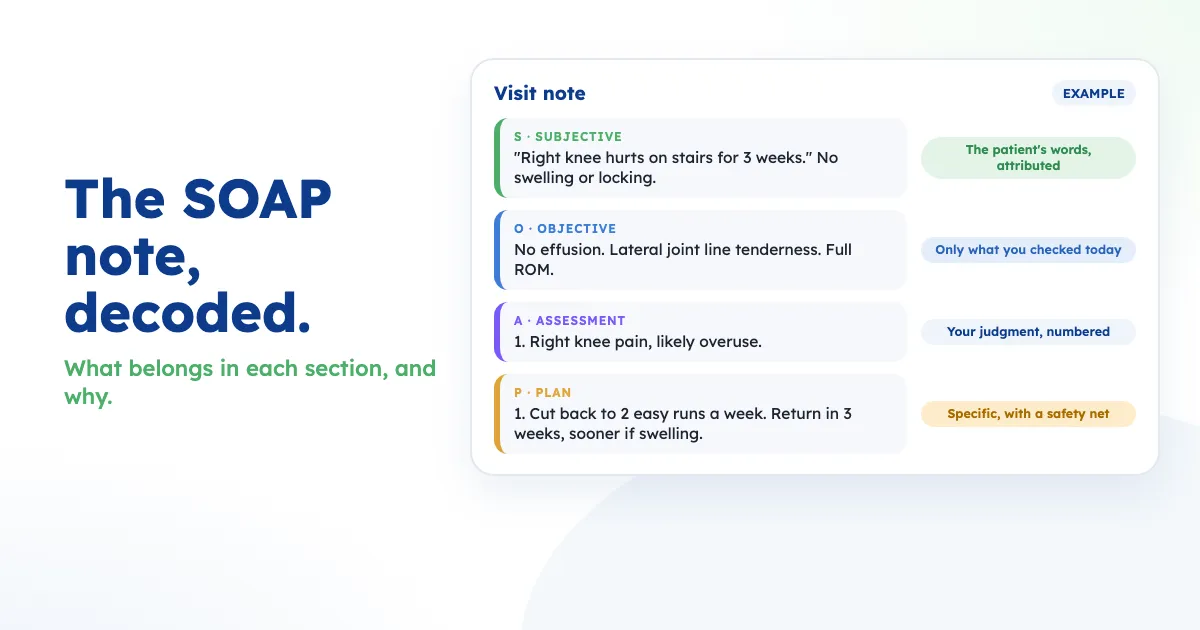
Most guides explain what the letters in SOAP stand for. If you already write notes every day, the harder questions are different: how much history you still need to document, what to do now that patients can read their notes, how to use templates without producing cloned notes, and whether the assessment and plan should come first. This guide covers those, with an example and a template you can adapt.
The Short Answer
A SOAP note documents a visit in four parts: Subjective (what the patient or caregiver tells you), Objective (what you observe and measure), Assessment (your clinical impression) and Plan (what happens next, and who does it). Keep each detail in its own section, make the plan specific enough that another clinician could pick up the case from your note alone, and write it knowing the patient may read it.
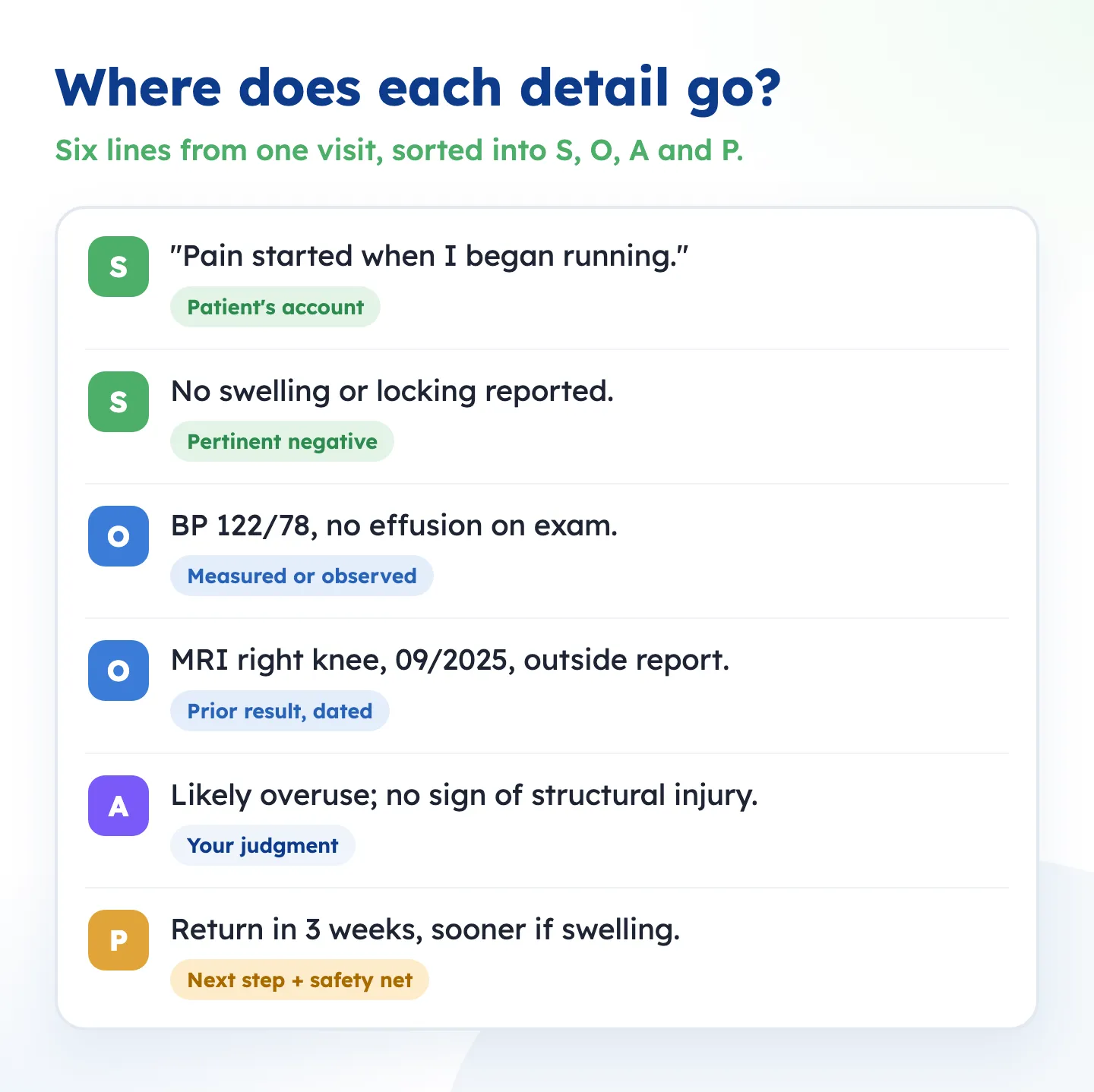
Subjective: The Patient's Account, Attributed
- Chief complaint in the patient's words, then the history of present illness: onset, location, duration, character, what makes it better or worse, and what has been tried.
- Pertinent negatives belong here too. "No swelling or locking" tells the next reader what you asked about and ruled out.
- Attribute every statement. "Patient reports" and "Per daughter" make the source obvious, which matters when a caregiver and the patient tell different stories.
- Medications as taken, not as prescribed. If the patient takes a medication differently from the label, the note should say so.
Objective: What You Observed and Measured
- Vital signs, the exam findings you actually checked (including relevant normal findings) and results of tests done during the visit.
- Results from outside records go here with their date and source, so a value from last year doesn't read as today's finding.
- Keep interpretation out of this section. "Lateral joint line tenderness" is objective; "consistent with overuse" belongs in the assessment.
Assessment: Your Judgment, Numbered
- Number each problem you addressed, most important first, so the plan can follow the same order.
- Give the reasoning a reader needs in a sentence or two: what you think is going on, what you considered, and what would change your mind.
- This is the clinician's section. Tools can organize what was said, but the assessment is your judgment.
Plan: Specific, per Problem, With a Safety Net
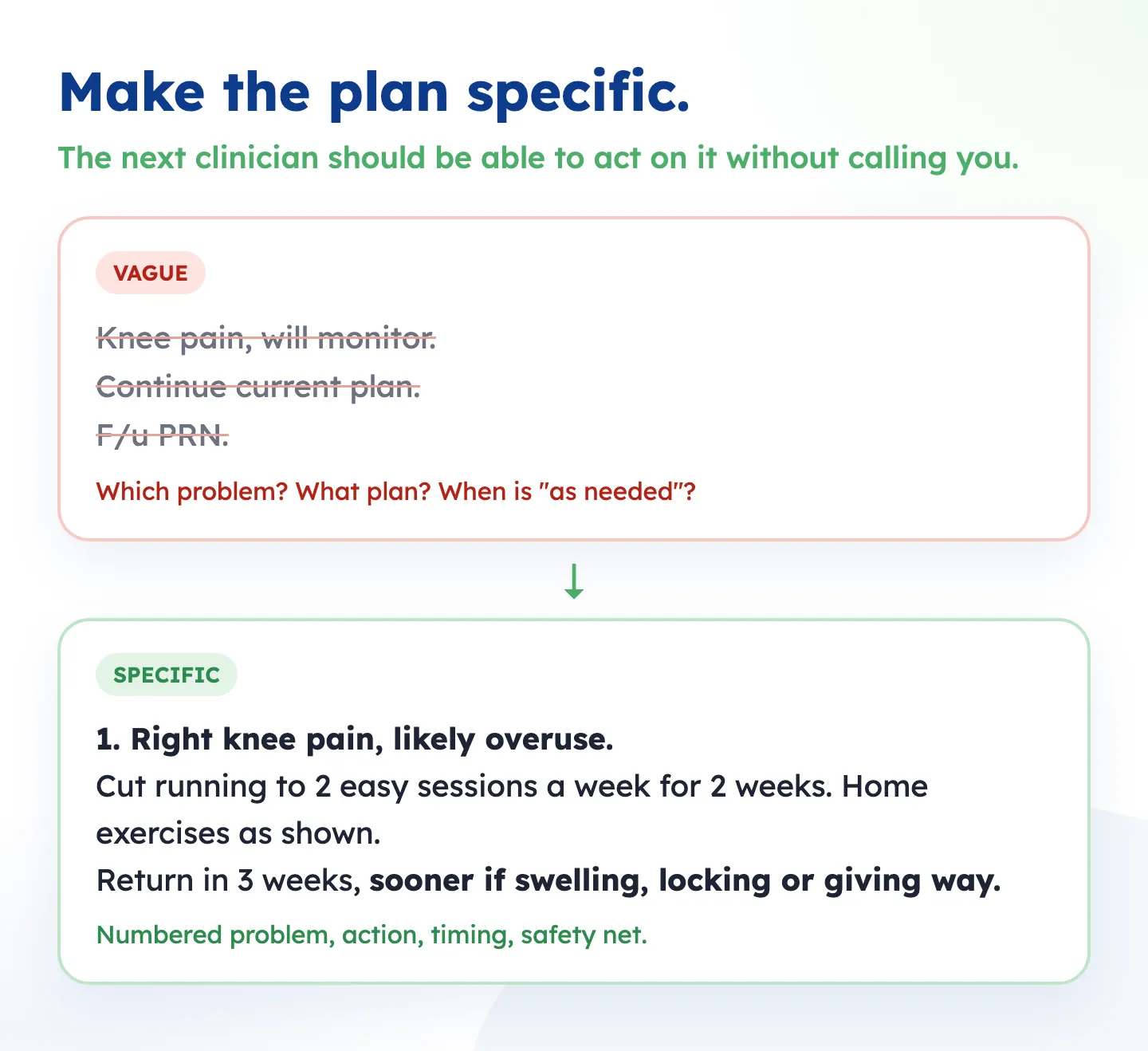
- For each numbered problem: what was ordered, started, changed or stopped, what the patient was told, and when they should return.
- Add a safety net: the specific signs that should bring the patient back sooner.
- Write it so the next clinician, or a covering colleague, knows exactly what was decided.
What Changed in 2021 for Office Visits
For office and outpatient visits, the 2021 evaluation and management guidelines changed how the visit level is chosen: it is now based on medical decision making or total time on the date of the encounter, and history and exam only need to be "medically appropriate" (CMS). The practical effect on your SOAP note:
- You don't need to pad the history or exam with every system to support the visit. Document what was relevant.
- If you code by decision making, make it visible in the assessment and plan: the problems addressed, the data you reviewed (outside records, tests ordered or reviewed) and the risk of the management options you discussed.
- If you code by time, document total time on the date of the visit and what it included.
Write It Knowing the Patient Will Read It
Since the information blocking rules of the 21st Century Cures Act took effect on April 5, 2021, patients can generally access their clinical notes, including progress notes, through the patient portal (OpenNotes). Research on clinical notes has found that negative or stigmatizing wording is common and that patients notice it (Becker's). A few habits help:
- Describe behavior neutrally: "has not started the medication" rather than "noncompliant".
- Use person-first language: "a person with a substance use disorder" rather than "substance abuser".
- Prefer "reports" to "claims" or "denies" when recording what the patient said.
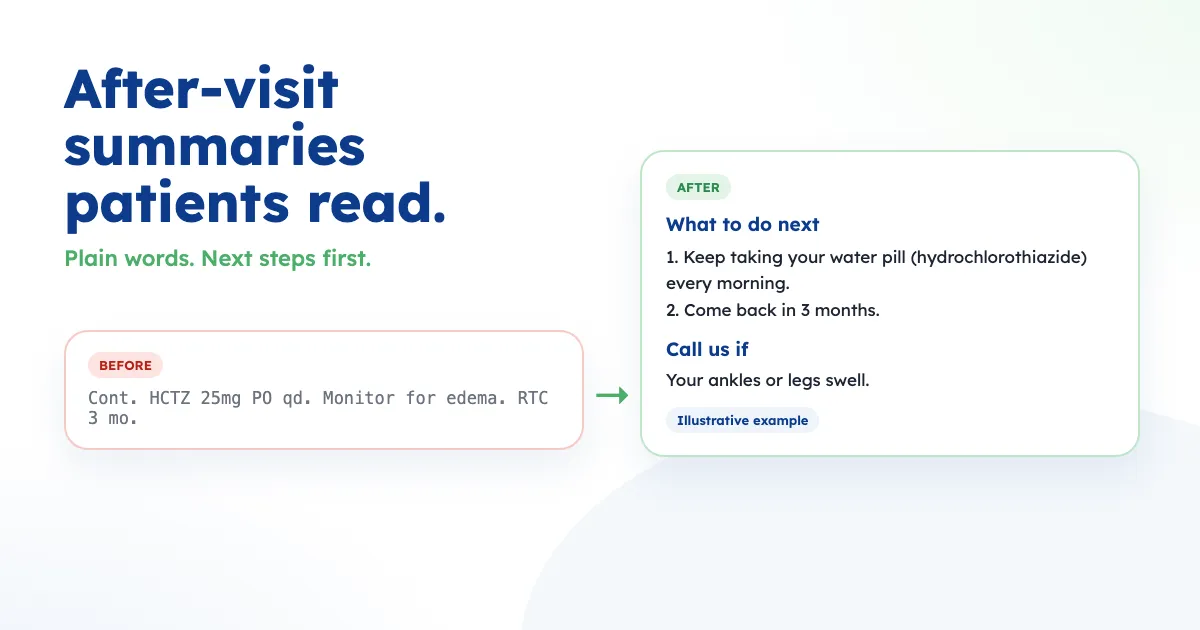
- Spell out abbreviations a patient wouldn't know, at least in the plan.
Templates Without Cloned Notes
Templates and macros are allowed, but CMS warns that copy and paste and cloning can lead to redundant and inaccurate information in the record and can raise authorship questions (CMS). Every note should reflect this visit:
- Use templates for structure, not for findings you didn't check today.
- When you carry forward history, update it and make clear where it came from.
- Read the copied text before signing. Stale medication lists and resolved problems are the usual errors.
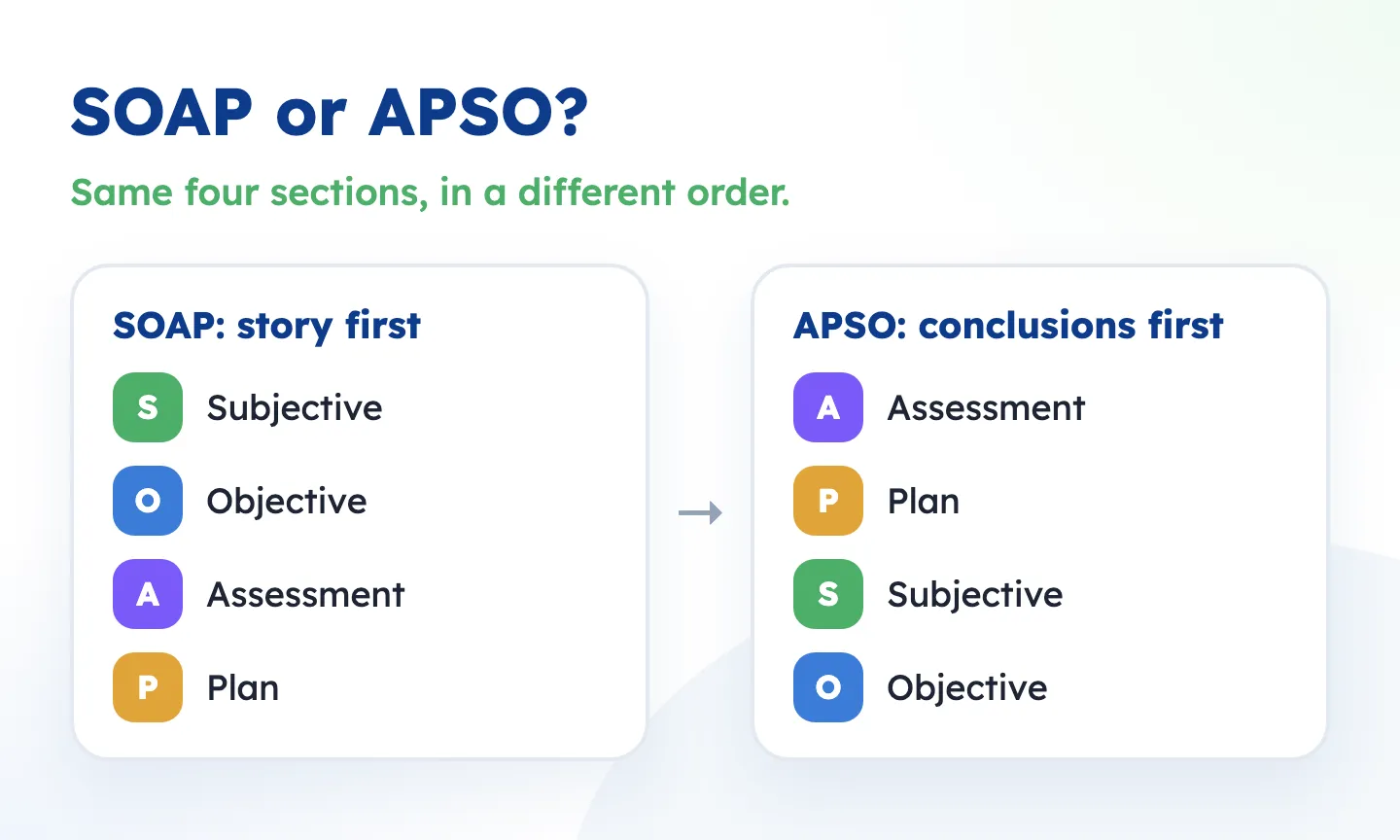
SOAP or APSO?
APSO puts the same four sections in a different order, with the assessment and plan first, because that's what most readers open a note to find. University of Colorado Health, for example, adopted APSO for most of its progress notes (Healthcare IT News). The content rules above apply either way; choose the order your colleagues expect to read.
A Worked Example
Illustrative example only, not clinical guidance.
S: 42-year-old reports right knee pain for 3 weeks, worse on stairs, since starting a running program. No swelling, locking or giving way. Ibuprofen gives partial relief. No known drug allergies.
O: Vitals within normal limits. Right knee: no effusion; tenderness along the lateral joint line; full range of motion; ligament exam stable.
A: 1. Right knee pain, likely overuse related to the new running program. No findings to suggest a structural injury today.
P: 1. Reduce running to two easy sessions a week for 2 weeks; home exercises as demonstrated. Return in 3 weeks, or sooner if swelling, locking or giving way develops.
A SOAP Note Template
| Section | Prompts |
|---|---|
| S | Chief complaint (patient's words). HPI: onset, location, duration, character, modifiers, what's been tried. Pertinent negatives. Medications as taken, allergies. Who gave the history. |
| O | Vitals. Exam findings checked today. In-visit results. Outside results with dates and sources. |
| A | Numbered problems, most important first, each with brief reasoning. |
| P | Per problem: orders, medication changes, education, referrals, follow-up and safety-net instructions. Total time, if coding by time. |
Common Mistakes
- Mixed sections: interpretation in the objective, or new history in the plan.
- Copy-forward errors: findings or problems that aren't true today.
- Vague plans: "Follow up as needed" leaves the next clinician guessing.
- Undated outside results.
- Writing it hours later, when details have faded.
Where an AI Scribe Fits
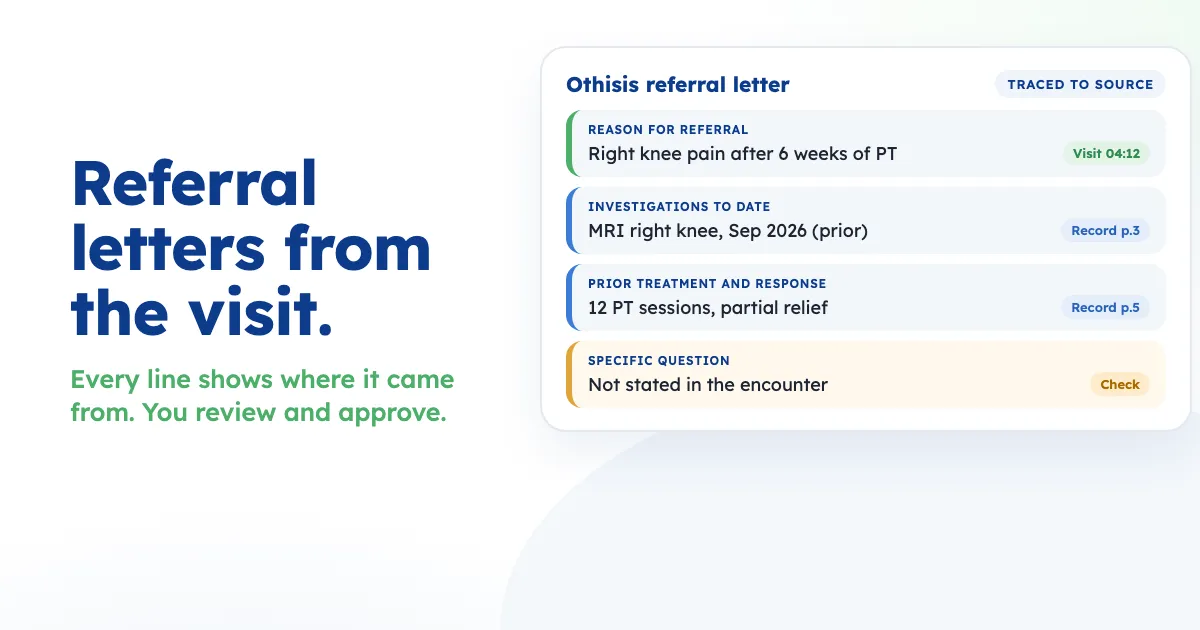
An AI scribe can draft the note from the visit conversation so you start from a structured draft instead of a blank page. Othisis is one system for the whole visit: it records the visit, drafts the SOAP note after you click Complete Session, lets you click a line Othisis wrote to see what was said, and lets you set up your own note templates. You review, edit and approve every note. The free Starter plan gives you 180 minutes of transcription and 25 PDF pages for your first month, with no credit card. Start free.
Othisis is a clinical documentation tool. It does not make clinical decisions, provide diagnoses or offer medical advice. This article is general information, not coding or legal advice.