
Here’s one question most clinicians fail to think about: what’s actually cheaper, paying someone $15 an hour or paying $149/$249 a month?
On paper, $15 an hour sounds like the better option. But when you actually go deeper and factor in all the hidden costs, you’ll start to think differently.
What Are the Hidden Costs Behind a $15/Hour Human Scribe?
Paying $15 an hour for a human scribe might sound reasonable at first, but many hidden costs are easy to miss. Human scribes require training and onboarding, supervision and regular quality checks, paid leaves, and consistent scheduling.
If a doctor uses a scribe for even 6-8 hours a day, the cost can easily cross $3000 a month. Over time, this will become a significant operational expense for clinics and hospitals. In fact, research shows that one of the biggest reasons doctors feel burned out is the large amount of documentation they need to complete, which makes it even more important to find cost-effective solutions.
An AI scribe works differently, typically on a fixed monthly subscription of $149 or $249 a month. At Othisis, Basic ($149) includes 9,000 minutes of transcription and 500 PDF pages a month, and Pro ($249) includes 15,000 minutes and 1,000 pages, with notes, letters, handouts and PDF summaries included. AI scribes don’t take two weeks to learn and don't require breaks. There are no hourly limits, overtime charges, or additional staffing costs, which makes the overall value of an AI scribe much more helpful.
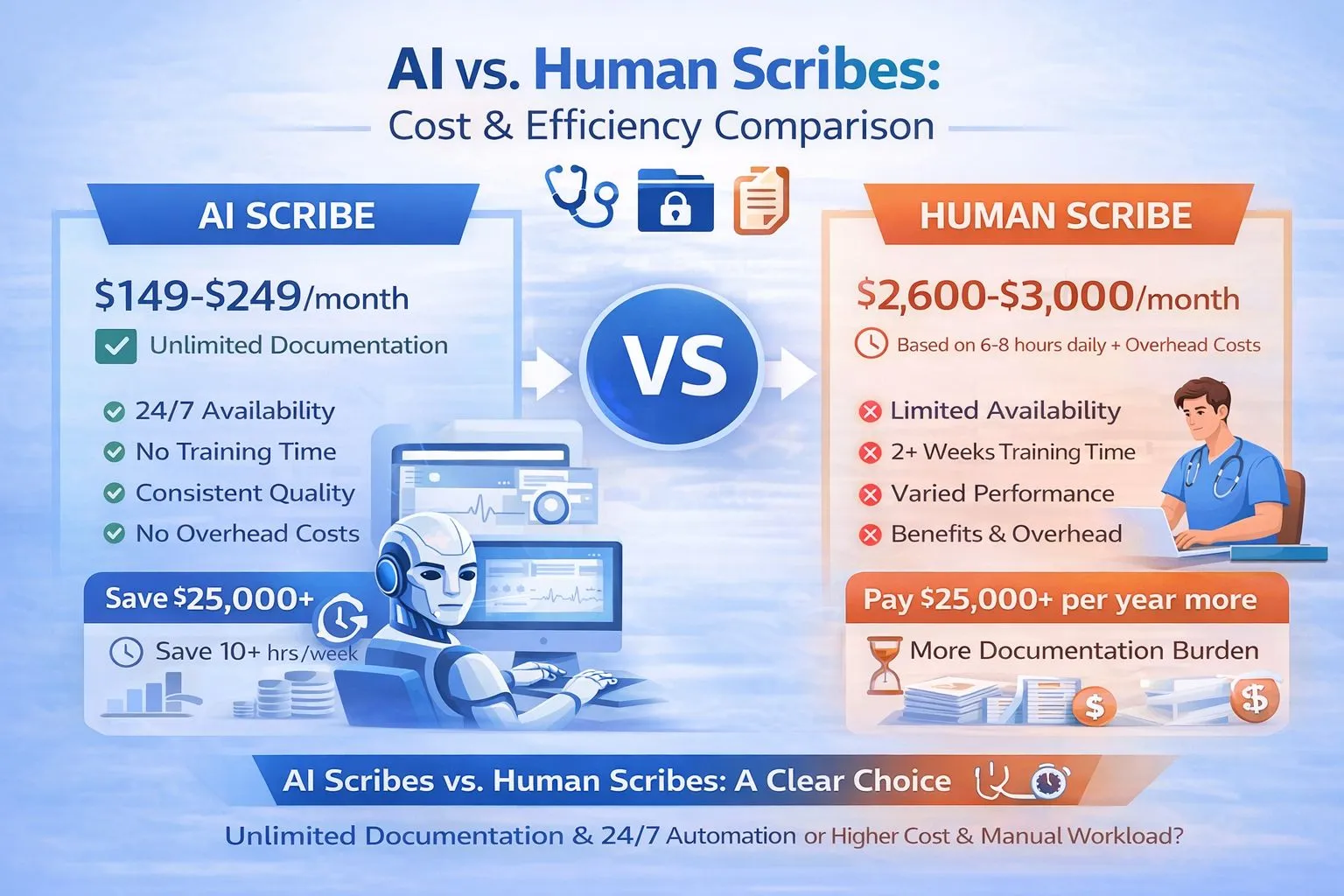
AI Scribe Vs Human Scribe Cost Comparison
AI Scribe: $149-$249/month with 9,000 to 15,000 minutes of transcription
Human Scribe: $15/hour = ~$2,600-$3,000/month (based on 6-8 hours daily usage) + training, benefits, and overhead costs
Annual difference: AI scribes can save clinics $25,000-$30,000+ per year compared to human scribes
Feature Comparison: AI Vs Human Scribes
|
Feature |
AI Scribe |
Human Scribe |
|
Cost |
$149-$249/month (9,000 to 15,000 minutes) |
$2,600-$3,000 for 6-8 hours daily |
|
Availability |
24/7, no breaks needed |
Limited to scheduled hours, requires breaks |
|
Training time |
Instant setup |
2+ weeks onboarding |
|
Scalability |
Up to 15,000 minutes a month |
Limited by human capacity |
|
Consistency |
Standardized output every time |
Varies by individual performance |
|
Overhead Costs |
None (subscription only) |
Benefits, sick leave, supervision, and insurance |
|
Quality Control |
Built-in accuracy checks through traceability |
Requires ongoing supervision |
|
Flexibility |
Works across multiple providers |
Typically dedicated to one provider |
What Does $249 A Month Actually Include?
The cost of an AI medical scribe is not about replacing a human with software, but rather about using a smarter system that makes your daily workflow more efficient.
At $249 a month, Othisis Pro covers 15,000 minutes of visits, about 45 fifteen-minute visits a day for one clinician over a 22-day month. On the other hand, hiring a human scribe means paying an annual salary of $32,000-$55,000 plus benefits, which breaks down to roughly $2,600-$4,500+ per month for just one scribe. And if your patient volume increases? You'll need to hire additional staff, multiplying those costs even further.
The ROI in Real Numbers: If an AI scribe saves you 2 hours daily on documentation, that's 10 hours per week freed up. It's time to leave the office on schedule, have dinner with your family, or simply decompress after a demanding day, without sacrificing quality patient care.
You also get features that manual documentation can’t match. Doctors can get easy access to the system from any device, get updates, and generate consistent SOAP notes, letters and handouts. There is no need to depend on shift timings, workload or different working styles.
How Do AI Scribes Improve Time Efficiency and Productivity?
You can save a lot more time with an AI scribe than you’d expect. With a human scribe, there is a lot to take into consideration, such as coordinating schedules, managing coverage during peak hours, keeping track of workflow and more.
An AI scribe, on the other hand, operates smoothly in the background. It automatically listens to patient-doctor conversations and converts them into structured clinical notes.
It is also more cost-effective when it comes to after-hours documentation. An AI scribe maintains the same monthly fee, whether it’s to document at 9 AM or midnight, without any worry of overtime fees. The average physician spends 1-2 hours per day on documentation, and AI scribes can cut this down to just 15-30 minutes. Studies indicate that AI scribes can reduce documentation time by 20-30%, allowing clinicians to focus more on patient care.
Is AI Scribe Accuracy Built For Healthcare Settings?
Human scribes can make errors, especially during long shifts. AI Scribe for Internal Medicine maintains a consistent performance throughout the day as they are built for clinical environments. They are trained in healthcare-specific language, understand complex terminology across fields like internal medicine or cardiology, and have the ability to differentiate between medications with similar names. Othisis also shows ICD-10 codes with confidence levels on insurance letters, for you to review. Beyond documentation, an AI scribe can also help create referral letters and patient handouts, cutting down on additional administrative work.
Traceability is another major advantage. You can click a line Othisis wrote to see what was said in the visit, so you can check accuracy at any time. Every note follows a standardized format, eliminating the inconsistencies that often occur when different human scribes document in their own styles. This consistency in performance is important from a compliance standpoint, as every note follows a standardized format.
How Can AI Medical Scribe Costs Help Scale Your Practice?
Whether you are running a solo private practice or a small clinic, scaling is difficult as it is; adding human scribe staffing to that list increases costs and management effort. With AI scribing, you can scale instantly without any extra training or hiring. Within your plan's minutes, the price stays the same however many patients you see.
The practical difference: Adding a provider means inviting them to your Othisis account, ready the same day (Basic includes 2 users and Pro 5; Enterprise covers larger teams). With human scribes, you're looking at weeks of recruiting, hiring, and training. Opening a second location doesn't require doubling your scribe staff and payroll; the same AI system works across all your locations. From a long-term planning perspective, AI scribes are much more efficient.
What Should Clinicians Consider When Choosing An AI Scribe?
Understanding which system is right for your practice comes down to looking beyond the hourly rate. It's about what you're actually getting for that cost. Look for templates that fit your documentation style instead of generic formats.
AI Scribes vs. Human Scribes: A Definitive Difference
|
AI Scribes Work Best for... |
Human Scribes Make Sense for... |
|
High-Volume & Scalability |
Specialized & Complex Encounters |
|
High-volume practices with 25+ patients daily and multi-provider practices looking to grow instantly. |
Specialties requiring extensive, non-standard narrative documentation and highly complex procedures. |
|
Cost Predictability |
Real-Time Interaction & Flexibility |
|
The predictable monthly cost makes them highly cost-effective and easy to budget. |
Situations where real-time clarification and asking follow-up questions during the encounter are crucial. |
|
Standardized Documentation |
Intricate Procedures |
|
Primary care and urgent care settings with standardized and repetitive documentation needs. |
Procedures where the physical presence of a scribe to observe and document intricate, non-verbal details provides superior accuracy. |
|
Operational Efficiency |
Direct Clinical Support |
|
Automated background operation with instant setup, 24/7 availability, and no overhead costs. |
Dedicated support to one provider, allowing for deeper, procedure-specific knowledge. |
For practices looking to reduce administrative work without sacrificing quality, the numbers speak for themselves. The shift to AI medical scribes is already happening, and practices making the move are seeing real savings in their budgets and real time back in their schedules.
As healthcare continues to evolve, investing in tools that give you more time with patients and less time on paperwork isn't just smart, it's necessary.
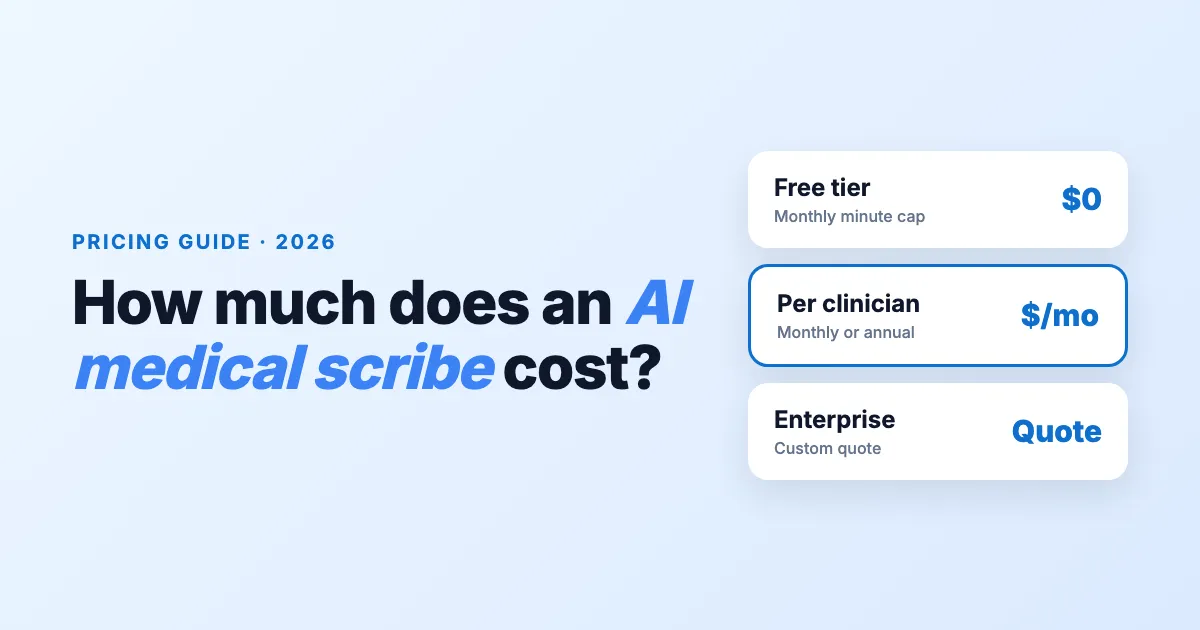
Comparing plans? See How much does an AI medical scribe cost in 2026? for a side-by-side look at free, per-clinician and enterprise pricing.