
More practices now see some patients who pay directly: people with high deductibles, people out of network, and services insurance doesn't cover. Each of those visits needs a price, and the price should be the same whether the front desk quotes it, the estimate shows it or the superbill lists it. This guide covers how to build a cash-pay fee schedule, how to set prices you can defend, how discounts and estimates fit in, and the mistakes that make cash pricing confusing.
The Short Answer
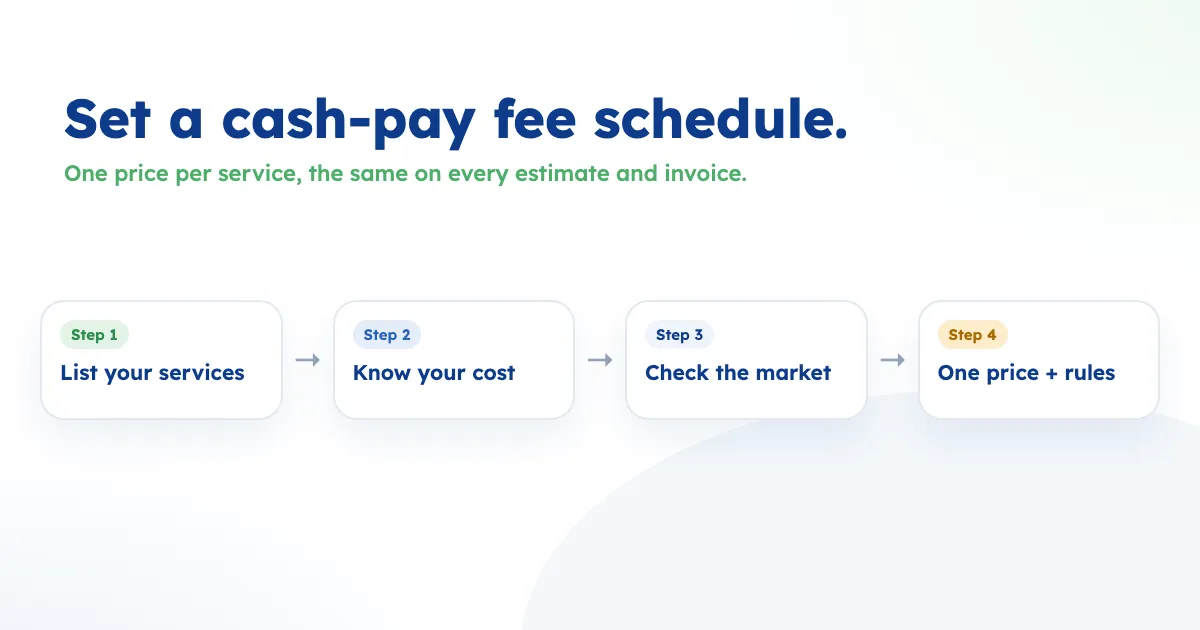
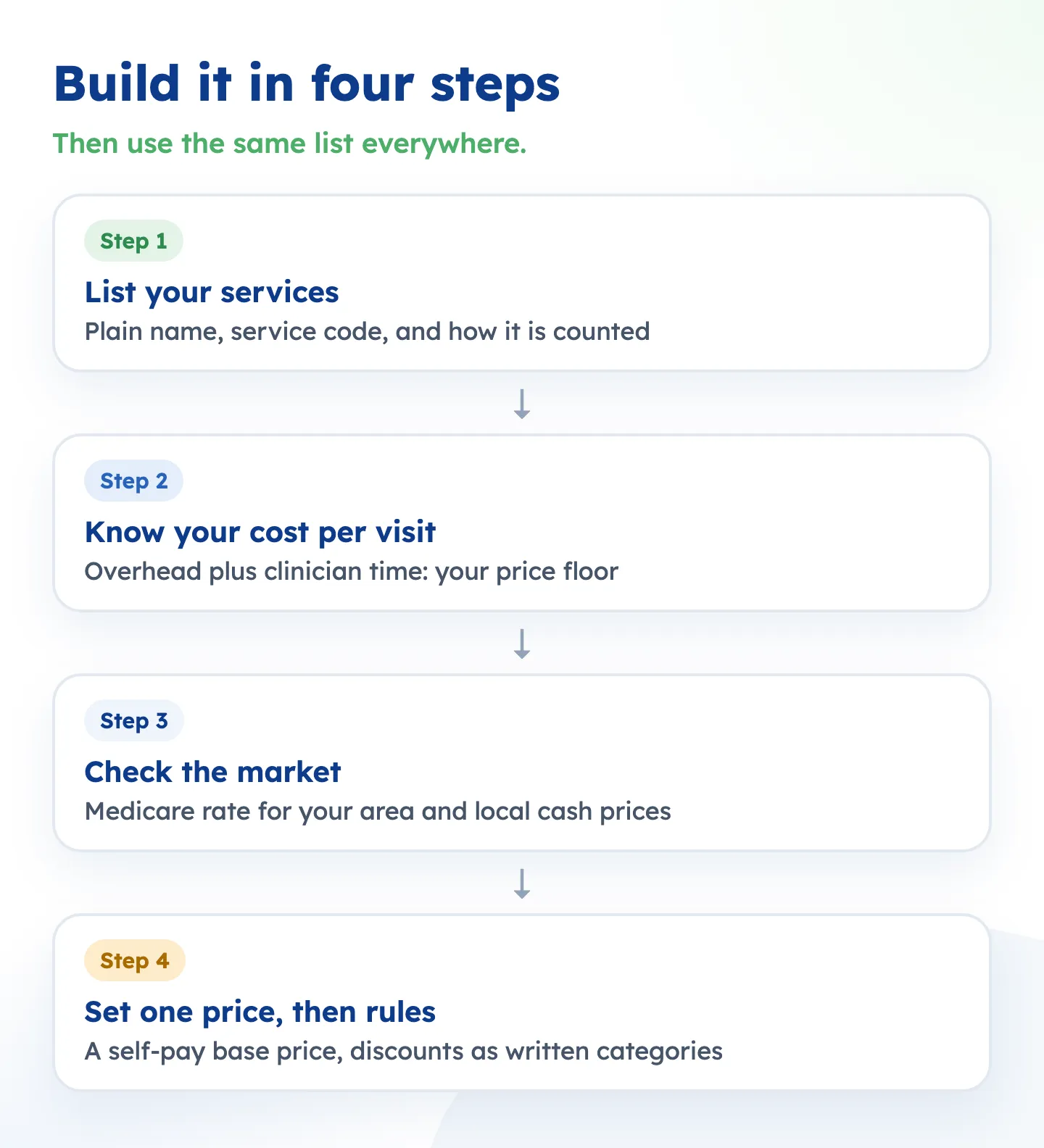
A cash-pay fee schedule is the price list your practice uses for patients paying directly. Build it in four steps: list the services you actually offer, work out what each one costs you to deliver, check what the market and Medicare pay for the same service, then set one self-pay price per service and apply any discounts as clear rules. Use the same list for every quote, Good Faith Estimate, invoice and superbill, and review it once a year.
Step 1: List the Services You Actually Offer
- Start from your last few months of visits, not from a full code book. Most practices bill a short list of services again and again.
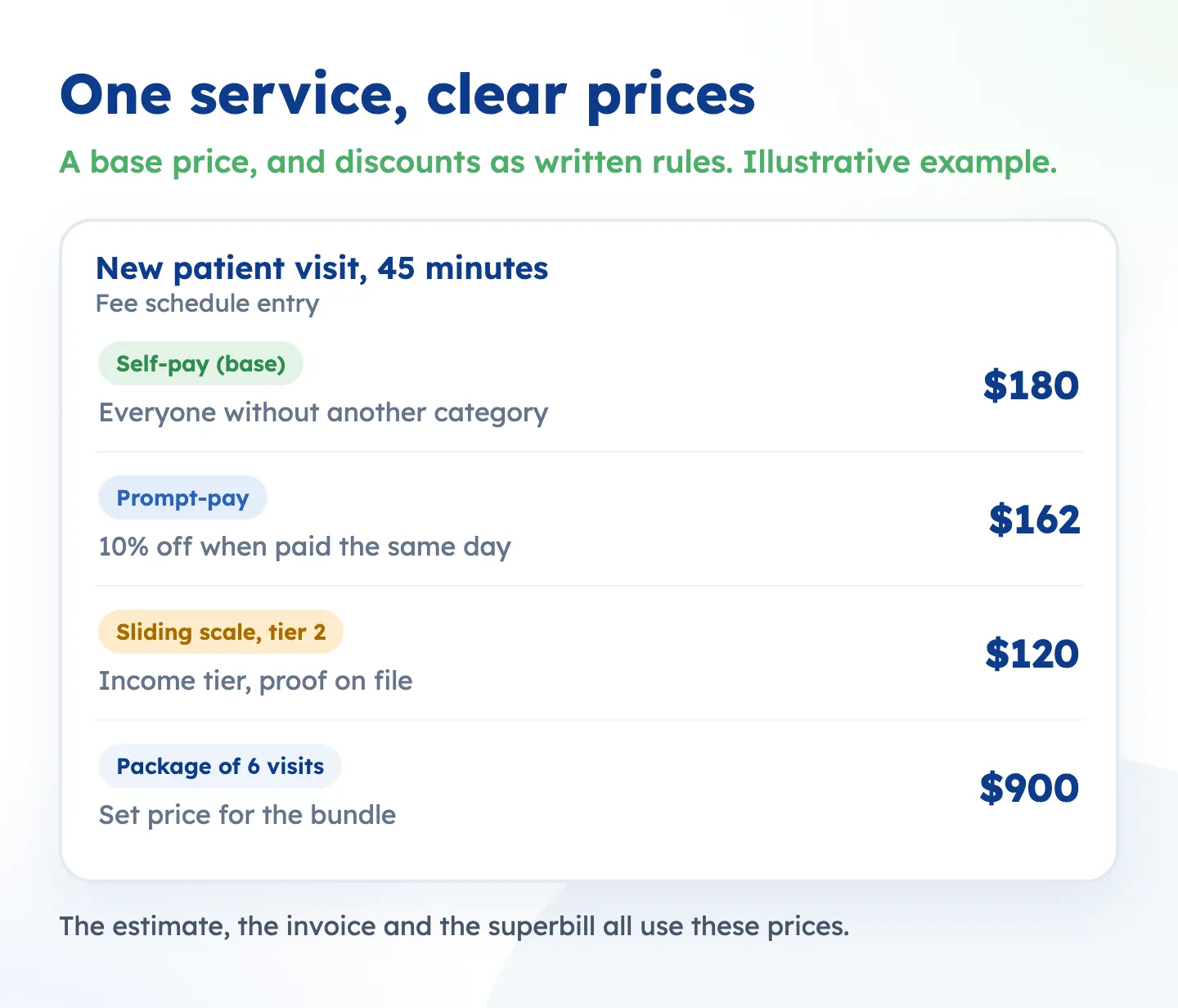
- Give each service a plain name patients understand ("New patient visit, 45 minutes") as well as its service code, and decide how it's counted: per visit, per unit, or per time block.
- Note add-ons that change the price, such as a longer visit or an in-office test.
Step 2: Know Your Cost per Visit
Your floor is what a visit costs you. Add up a year of overhead (staff, rent, software, insurance, supplies), divide by the clinical hours you actually bill, and add the clinician's time. If a 30-minute visit costs you $95 to deliver, a $90 cash price loses money on every visit, however busy the schedule looks.
Step 3: Check the Market and a Public Benchmark
- Medicare as a reference point. CMS publishes what Medicare pays for each service by locality in its Physician Fee Schedule lookup. Many cash practices set prices as a multiple of the Medicare rate so the logic is easy to explain.
- What patients see elsewhere. FAIR Health Consumer shows typical charges in an area, which is what patients often compare you against.
- Local cash prices. Many cash-pay and direct-care practices publish their prices. Check a few nearby.
Step 4: Set One Self-Pay Price, Then Discounts as Rules
Keep one base self-pay price for each service. If you offer lower prices, make them categories with written rules rather than case-by-case decisions:
| Category | How it works | Example rule |
|---|---|---|
| Self-pay (base) | The standard cash price | Everyone without another category |
| Prompt-pay | A percentage off for paying at the visit | 10% off when paid the same day |
| Sliding scale | A lower price based on income | Tiers tied to household income, with proof on file |
| Package or membership | A set price for a bundle of visits | Six physical therapy visits for one price |
Apply each rule the same way for every patient who qualifies, and write it down. If you see Medicare or Medicaid patients, discounts and waived cost-sharing have their own rules, so check with your counsel before you offer them.
Make Estimates and Invoices Match
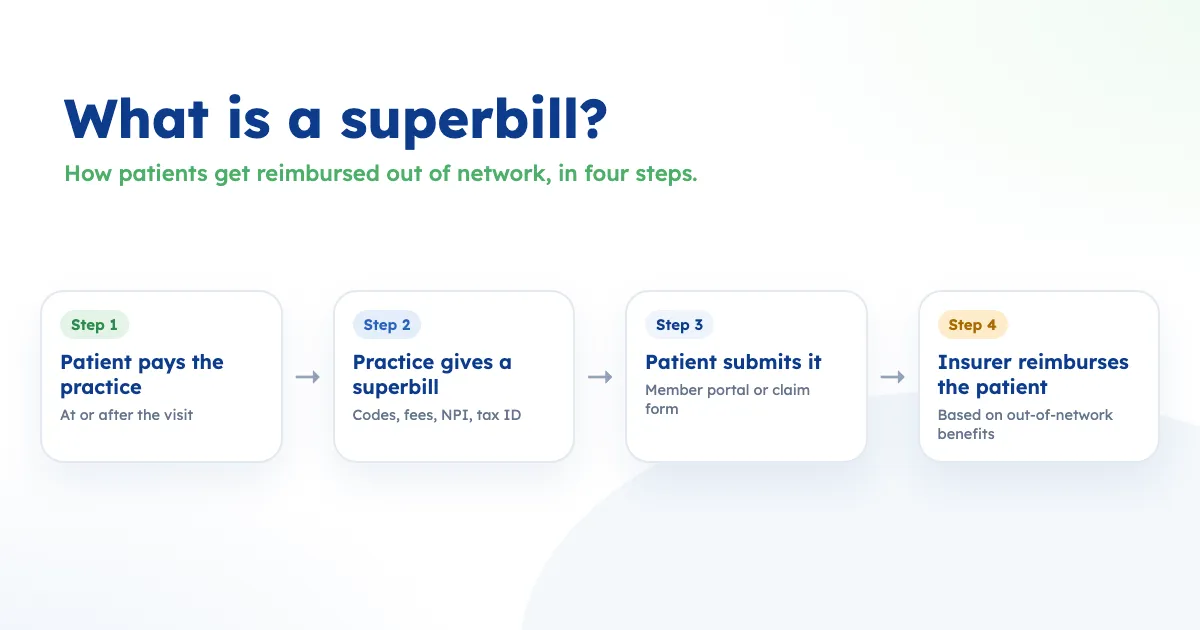
Under the No Surprises Act, uninsured and self-pay patients must get a Good Faith Estimate when a service is scheduled at least three business days ahead or when they ask for one, and they can dispute a bill that comes in substantially higher than the estimate (CMS). A single fee schedule makes this simple: the estimate, the invoice and the superbill all draw on the same prices, so the numbers agree.
Common Mistakes
- Copying your insurance chargemaster. Those list prices are set for negotiation with payers, not for patients paying directly.
- Pricing below cost because a competitor does.
- One-off discounts decided at the front desk, which make prices inconsistent and hard to defend.
- Different numbers in different places: the website, the estimate and the invoice each showing a different price.
- Never reviewing it. Costs and local prices change every year.
Checklist
- Every service you offer has a plain name, a service code and how it's counted.
- Each price covers your cost per visit.
- Prices are checked against Medicare and local cash prices.
- Discount categories are written rules, applied the same way to everyone.
- Estimates, invoices and superbills use the same list.
- A yearly review date is on the calendar.
Keeping Prices Consistent in Othisis
In Othisis, the fee schedule holds a self-pay base price for each service, and extra rate categories can take a percentage off, a dollar amount off, or a price you set by hand. When a cash-pay visit is priced, its invoice and superbill come from that fee schedule, and you review them before giving them to the patient. Othisis doesn't submit insurance claims. Learn more about cash-pay billing and superbills, or read what a superbill must include.
This article is general information, not billing, tax or legal advice. Othisis is a clinical documentation tool. It does not make clinical decisions, provide diagnoses or offer medical advice.