
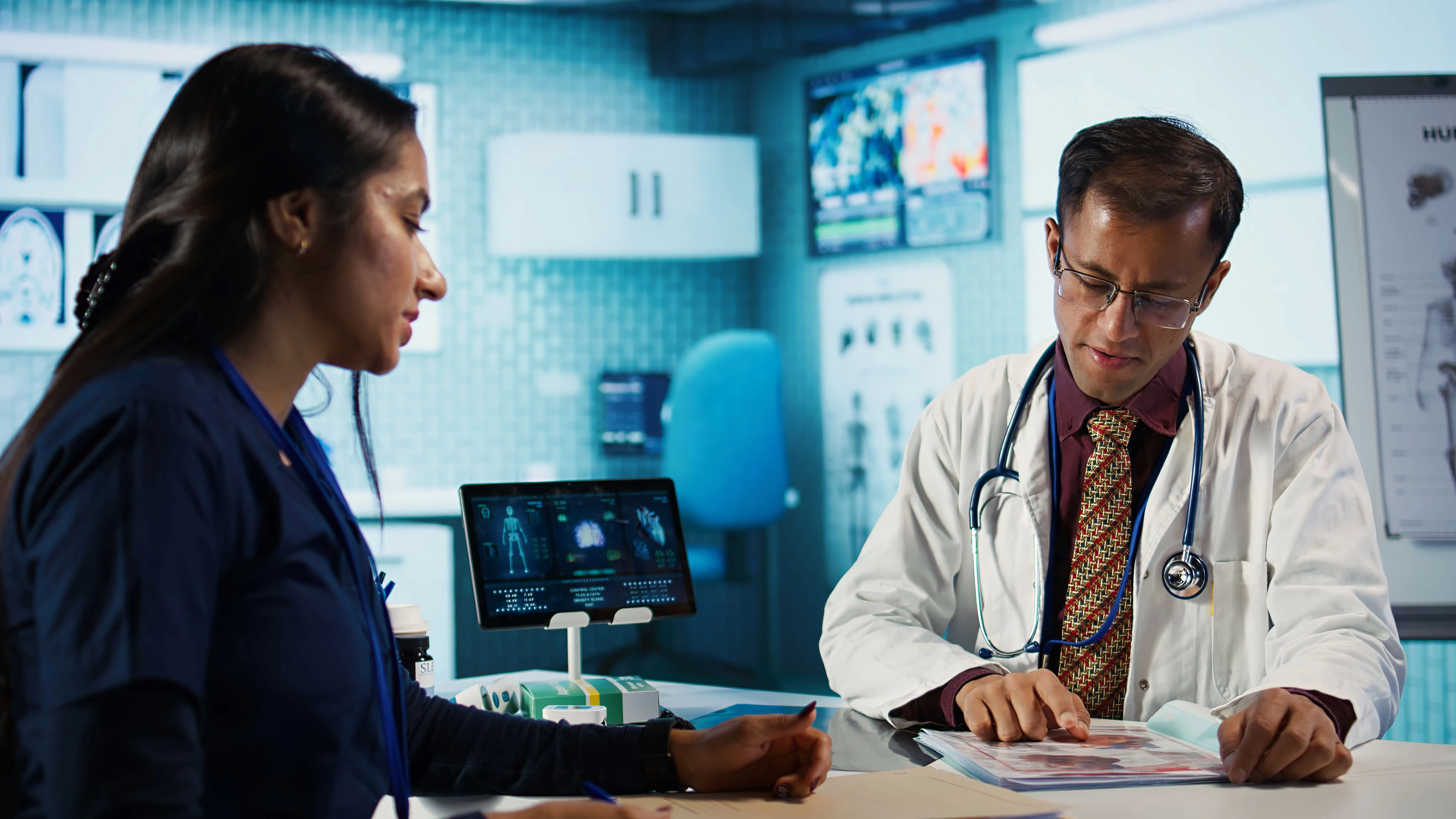
A clinician finishes their last patient at 6 PM. Two hours later, they are still at the desk writing notes. For many independent practitioners, this is not an exception. It is the default.
Most ROI conversations about AI for clinical documentation stop at one metric: minutes saved per note. That metric is real, but incomplete. The actual return is distributed across the full visit cycle.
Where Does Time Actually Go in a Documentation-Heavy Practice?
Documentation time is rarely lost in one place. It spreads across the day in small increments that add up.
Time is lost at these specific points:
- Scanning multi-page prior records before a complex visit (5 to 10 minutes per patient)
- Writing notes from memory after the session ends (10 to 15 minutes per note)
- Completing documentation after clinic hours
The mental work of reconstructing a visit into a compliant note is where source traceability AI becomes a quality control issue, not just a convenience.
A trial published in NEJM AI found that ambient AI scribes reduced documentation time by 30 minutes per day per provider. For a solo practitioner seeing 18–20 patients daily, that gap accumulates quickly.
How Does Pre-Visit Summarization Reduce More Than Prep Time?
Pre-visit preparation is one of the least-discussed ROI drivers in clinical AI and one of the most impactful.
A verification-first system reads uploaded patient records and produces a structured summary before the visit. Each detail carries a confidence score and links back to its source. The clinician verifies rather than blindly accepts.
The Othisis PDF summarization tool turns a full record review into a verification pass, because each summary point links to its page in the source. The gain is not just time. It is also the quality of attention the clinician brings into the room.
What Is the ROI of Clinician-Controlled Note Review?
AI for clinical documentation generates draft notes from the post-session transcript, but the value of those notes depends on whether the clinician can verify them.
In a verification-first system, the transcript and draft appear side by side. The clinician clicks any section, and the corresponding transcript moment opens immediately.
Research from JAMA found clinicians using ambient AI spent 8.5% less total time in the EHR and over 15% less time composing notes. The review process is faster when every output shows its source.
|
ROI Area |
Without Purpose-Built AI |
With Verification-First Documentation |
|
Pre-visit preparation |
Manual review of lengthy records |
Structured PDF summaries with traceable source links |
|
Note accuracy |
Memory-dependent, variable quality |
Draft generated from post-session transcript |
|
After-hours documentation work |
10+ hours of catch-up per week |
Structured drafts ready after each session, resulting in less after-hours work |
|
Audit readiness |
No source traceability or version history |
Click-to-source traceability and version history |
|
ICD-10 clarity |
Codes entered manually with no confidence context |
ICD-10 codes on insurance letters, marked by confidence |
Why Do Small Clinics See the Highest Return from AI for Clinical Documentation?
Large health systems have documentation staff and administrative layers. Independent clinics carry the burden themselves.
AMA research found that among physicians using ambient AI scribes:
- 82% reported improved work satisfaction
- 84% reported a positive effect on patient communication
- Departments with the highest documentation burden saw the highest adoption rates
These outcomes are especially significant for small practices, where physician retention depends on sustainable workloads.
What Is the Hidden ROI of Purpose-Built Medical AI in Clinical Documentation?
Verification-first documentation is a specific approach to AI for clinical documentation, one built around clinician control at every step.
Unlike generic transcription tools, a purpose-built AI medical scribe for internal medicine understands the complex diagnostic reasoning and longitudinal patient history required for comprehensive care.
The workflow follows a clear sequence:
- Pre-visit PDF Summarization with Confidence Scoring: Records are summarized before the visit. Lower-confidence details are highlighted for review before the patient arrives.
- Post-session Transcription and Structured Note Generation: After the consultation, structured drafts are generated. SOAP notes, referral letters, insurance summaries, and patient-facing summaries all come from a single reviewed transcript. Nothing is finalized without clinician approval.
- Source Traceability: Click a line Othisis wrote to see what was said in the visit. The clinician clicks any section to reach the exact transcript moment or source passage.
- PDF Confidence Scores: Some PDFs, like scans or low-quality files, don’t extract cleanly. A confidence score shows how reliable the extracted text is:
> 90%+ (Green): Reliable
> 70–89% (Yellow): Review recommended
> <70% (Red): Verify manually
- ICD-10 Coding Cues with Confidence Colors: On insurance letters, each ICD-10 code is marked high, medium or low confidence, so you know which codes to check. This is a documentation clarity feature, not a coding system.
- Version History: Each saved version of a note shows who saved it and when, and you can restore recent versions.
The accountability layer is what generic tools consistently miss. This is where Othisis AI medical scribes earn their return, not only in speed, but also in documentation that holds up under scrutiny.
Beyond Time Saved: The Full Return on AI Documentation
The full ROI of purpose-built AI for clinical documentation is not captured in a single efficiency metric. It is distributed across pre-visit preparation, post-session note review, documentation accuracy, and the long-term reduction of after-hours burden.
Independent clinics stand to gain the most, not because they see the fastest time savings, but because they absorb the highest cost when documentation is inefficient. Practices that evaluate these tools at the workflow level will find the returns are broader than advertised.